Skt.. Mariae Klosterkirke
Mariakyrkan
Carmelites
Mariakyrkan
Carmelites
Knock. The Door Opens.
Worship includes Box Seats in balconies, behind screens;
and Commerce, Is That so? Who matters?
No different from now.
The Ships from the Rafters
Worship includes Box Seats in balconies, behind screens;
and Commerce, Is That so? Who matters?
No different from now.
The Ships from the Rafters
Ske. Mariae Klosterkirka, or Saint Mary's Church, Mariakyrkan, and the Carmelite Cloister, Monastery of Our Lady
Wonderful. In Helsingborg, the Town where the Ferry Lands from Sweden.
Go here instead of Kronborg Castle, if you must choose.
First, a fabulous little knocker, at the complex of Saint Mary's Church, Mariakyrkan, and the Carmelite Cloister in Helsingor, Denmark. Helsingborg, similar name, is in Sweden, just a few miles across the water. Take a ferry.
Helsingor is the place of Elsinore, Kronborg Castle, that gets all the attention and has become rather tacky. Even the ticket-takers look and act weary. Another tourist. Oh, dear. Must we bother.
We did Kronborg, as required, but prefer other parts of Denmark's history in this old town, so close to Sweden. Here is our first encounter: a knocker. We have to look up the symbolism of the pop-eyed dolphin, with a little ersatz cherub without wings on the dolphin's back. The dolphin does not look happy. A coercive, nasty cherub. Meanwhile, knock and enter.
 Dolphin Knocker, St. Mary's, Helsingor DK. Sancta Maria Klosterkirke. Mariakyrkan.
 Saint Mary's Church, and a Monastery, the Klosterkirka in Helsingor, Denmark. Mariakyrkan
This is a Carmelite Monastery dating from the 1400's. Carmelites: a long history dating from the Crusades and Orders living in Palestine, of hermit-like monastics, but they live in a "shared solitude" see ://www.carmelites.net/tradition/history.html
 Famous organist, composer, Buxtehude, at St. Mary's Church, buried in Helsingor, DK. Ste. Maria, Klosterkirka. Mariakyrkan.
At the age of 20, Buxtehude became organist here at S. Maria.
 Door ornamentation, symbolism unknown. Sancta Maria Klosterkirka, Helsingor, DK. Cloister church. Mariakyrkan
We need a compendium encyclopedia of symbols and patterns. Doors are fabulous, but what do the shapes mean.
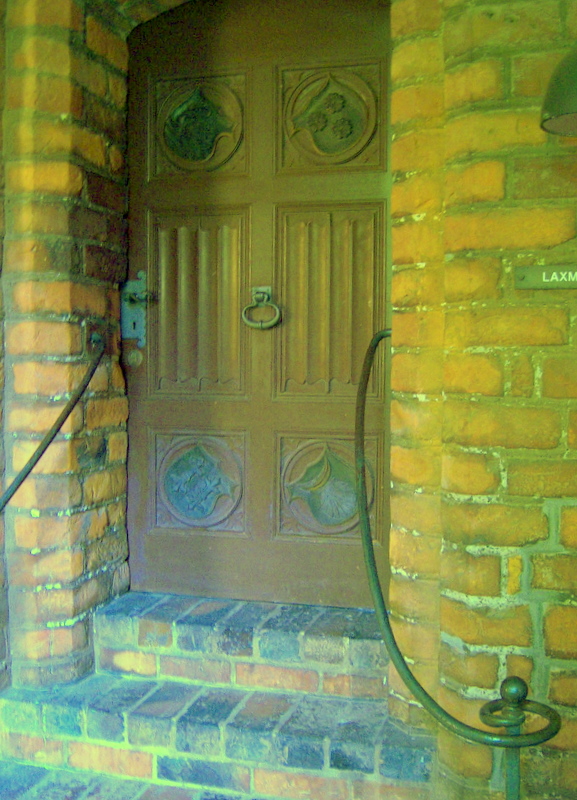 Entire door,orown symbols, Saint Mary's Helsingor DK; and Cloister. Mariakyrkan.
The details are unfamiliar, but the grace is laudable. Look a that curved railing, with the monkey-tail ending. We used to love sliding down big mahogany bannisters as kids with monkey-tail curlicues at the end to stop you, and here one is. Swoosh better than Nike.
 Pulpit, Sancta Maria, Klosterkirka, Helsingor, DK.
 The interesting angle here is all the pregnant women. There are the usual saints, and Matthew etc., but more interesting are the bulging bellies of the women representing various virtues. Where to get information on that? Because this is St. Mary's and she was "enceinte"?
 Ladies with child representing virtues; not just fashion bulges, to look at them. St. Mary's, Helsingor, DK Mariakyrkan.
Don't nobody tell the Vatican that these are here. Look between St. Luke, there and the next gospeler, and see the shapes. That is real life. We enlarged it here so you could see. If you like, if it disturbs you, click on the picture and make it small.
 Patience; a virtue represented by a cowering, even pregnant lady, St. Mary's, Helsingor, DK Mariakyrkan.
The photo is fuzzed because we are not professional, but look there and see if youoree. That is not a noble, patience. That is someone under stress. Thank you, church, for putting her in that position.
. Mariakyrkan.
 Worship Boxes; private rooms with their own windows to the church below, where the wealthy family could retire up the curved (also private) staircases, Sancta Maria, Klosterkirka, Helsingor, DK
  |
In August of each year, Helsingor hosts the Baltic Sail, where ships anchor in the harbor, and there are booths and entertainment and -- is this like the Tall Ships in the US, where towns along old harbors, from NY to the smaller, have celebrations of old ships?
Note the lovely spiral carved staircase leading to the private worship boxes.
 Weathy patron worship box, St. Mary's Klosterkirka, Helsingor Denmark
Worship skyboxes.
In Mariakyrkan, the pews are ornamented with upstanding scallop shells, long the symbol of pilgrims. See ://seagrant.gso.uri.edu/factsheets/scallop.html/. The Church is brick, as this is an area with out mountain rocks for building material.
Back to use of female figures for the Virtues. Do tell the Vatican.

 St. Mary's Carmelite Cloister Church, Helsingor DK; Skt Mariae Klosterkirke. Monastery of Our Lady. Cloister garden.
  Boar's head at the Last Supper, St. Mary's Cloister Church, Helsingor DK. Also other scenes: flight into Egypt, Herod the baby-killer (no outside evidence for that?); a healing?
 Closeup. No mistaking. That's a boar's head at the Last Supper. Skt Mariae, Carmelite Cloister Church Helsingor DK
 ,Frescoes, St. Mary's Cloister Church, Helsingor DK. Judas and the kiss, sleeping disciples in the garden, cup pass from me, etc.
 Scourging, thorns, carrying the cross, crucifixion. Ceiling arch frescoes, Skt. Mariae, Klosterkirke, Helsingor DK, St. Mary's.
 .Burial marker, floor,Frederick II but not the King (at Roskilde); St. Mary's Klosterkirke, Helsingor, DK.
 ,,
,, Organ view, Buxtehude's. St. Mary's Cloister Church, Helsingor DK