Glavendrup Part II
Meaning of Drill Holes in Rune Stones
Search for Ragnhild, who erected the Stones.
Stone Ship Site: Ragnhild honors Husbands Alle and Gunnulfr
Part I at http://denmarkroadways.blogspot.com/2011/07/glavendrup-viking-stone-ship-ragnhild.html
Ragnhild erected a stone-ship Glavendrup,
rune stones including Tryggevaelde with many drill holes, at the Danish National Museum, Copenhagen.
Two remain at Glavendrup with solitary drill holes.
Meaning of Drill Holes in Rune Stones
Search for Ragnhild, who erected the Stones.
Stone Ship Site: Ragnhild honors Husbands Alle and Gunnulfr
Part I at http://denmarkroadways.blogspot.com/2011/07/glavendrup-viking-stone-ship-ragnhild.html
Update: August 3, 2013. See 4.7
below. Is Ragnhild's use of drill holes in the stone ship standing stones also to
signify her origins in Norway, area of the distinctive Torghatten rock
formation with its tunnel hole on Torget Island, Norway, once an area of
the Nitherians, Nidaros? Scroll down for this latest entry, the
Torghatten rock connection, possible.
Ragnhild erected a stone-ship Glavendrup,
rune stones including Tryggevaelde with many drill holes, at the Danish National Museum, Copenhagen.
Two remain at Glavendrup with solitary drill holes.
What do they mean?
Then read the comment, with yet another possibility.
Then read the comment, with yet another possibility.
.....................................................................
I. Ongoing Mystery I.
Holes in Stones at Glavendrup Stone Ship Site
Why, Ragnhild?
Holes in Stones at Glavendrup Stone Ship Site
Why, Ragnhild?
1. Who is Ragnhild. See her stone ship in Denmark at http://www.vikingdenmark.com/glavendrup-stone-ship-runic-stone-funen-denmark.html. The date is given as early 10th Century.
Ragnhild is a woman of the Scandinavian Viking era, 10th Century. She is a person of means, who can afford not one but two rune stones and at least one stone ship for her husbands, that at the same time pay deserved tribute to herself for doing it. I did this. Good for her. She erected Glavendrup rune stone for Alle, a priest and clan chieftan. She erected Tryggevaelde rune stone for Gunnefi, a "clamorous" man.
Pronounce Ragnhild as "Wrong-heel" says http://forum.wordreference.com/showthread.php?t=644001.
Name itself. The name itself, Ragnhild, has come down to us as "regin" for advice, and "hildr", for battle. Ragnhild is no mere domestic goddess, the the shadow of the other. See http://www.behindthename.com/name/ragnhild If a woman is wealthy and powerful, this elaborate setting demonstrates that she can show it. Was there polyandry at that time? Or was this a more modern sequential monogamy, after casting one aside; or widowhood.
This stone-ship formation is at Glavendrup, in the woods. See it at http://denmarkroadways.blogspot.com/2011/07/glavendrup-viking-stone-ship-ragnhild.html. There are two stones there with holes drilled through at top, to the side. A third, Tryggevaelde, is in the Copenhagen Museum, and we did not see it. See it at FN 1, Wikimedia Commons. The holes are unexplained.
2. What is the meaning of the drill holes.
At the Glavendrup stone ship site are two stones with drill holes: Here, the first, with a front view of the stone hole.
 Glavendrup stone ship, Denmark. Burial commemoration stone, drill hole. erected by Ragnhild.
A second stone ship stone, same location, shows the hole off to one side, and a vaguely heart-shaped drill hole.
 |
Be still, heart.
The heart shape means courage in the old symbolism, the heart as the seat of courage, warlike virtue. See http://rua.ua.es/dspace/bitstream/10045/10394/1/RAEI_21_03.pdf. This stone bears some resemblance to the heart, but beyond that, we cannot go. There is a modern stone erected to Ansgar, Apostle of the North, with a heart also on it, see the Glavendrup Part I site.
 Glavendrup DK stone ship, stone drill-hole, rear view.
 3. Who were the people commemorated.
Parse the runes and the meaning so far. They tell us she has relatives, and was married, at least two times.
- Stone 1: Glavendrup, erected by Ragnhild to honor, as written in runes,
- Alle, who was
- her husband, and a
- clan chieftain, and
- priest of the Soelve.
- There was a Soelve Soelvedal who went with Erik to colonize Greenland, see http://usazweb.com/lib/news/Norse-Discovery-of-America.html
- Gamers find Soelve, Sea-King Jutland, in Pendragon, see http://www.scribd.com/doc/37672574/Pendragon-Chaosium-2718-Land-of-Giants
Soto carved the runes. Who is Soto? A slave? A superior?
- Stone 2: Tryggevaelda, now at the National Museum of Denmark in Copenhagen, see FN 1, and erected by Ragnhild to honor, as written in the runes,
- another husband, Gunnulfr, who was
- a "clamorous" man.
- Ragnhild is the sister of Ulfr.
- Gunnulfr is son of Nerfir.
%20or%20CC-BY-SA-3.0%20(http://creativecommons.org/licenses/by-sa/3.0)],%20via%20Wikimedia%20Commons%22%20href=%22http://commons.wikimedia.org/wiki/File%3AThe_Tryggev%C3%A6lde_Runic_Stone.jpg%22%3E%3Cimg%20width=%22256%22%20alt=%22The%20Tryggevælde%20Runic%20Stone%22%20src=%22//upload.wikimedia.org/wikipedia/commons/thumb/5/53/The_Tryggev%C3%A6lde_Runic_Stone.jpg/256px-The_Tryggev%C3%A6lde_Runic_Stone.jpg%22/%3E%3C/a%3E) Tryggevaelda, Rune Stone erected by Ragnhild, National Museum of Denmark, WikimediaCommons
Tryggevaelda, Rune Stone erected by Ragnhild, National Museum of Denmark, WikimediaCommons- See inscription and same site, http://en.wikipedia.org/wiki/Tryggev%C3%A6lde_Runestone ; http://www.encyclo.co.uk/define/Tryggev%C3%A6lde%20Runestone
4. Search for Ragnhild. Several stories of other (some same?) Ragnhilds
4.1 Was this the same Ragnhild, daughter of Hakon who was King of the Nitherians? Here is the old historian Saxo's account of Danish history-myths.
4.1 Was this Hakon the same as one Hadding. Similar spellings, sounds. Hadding.
Hadding is a hero. He is said to be called "Ing" by his people, see http://www.sacred-texts.com/neu/tml/tml14.htm
[The King Inge buried at Vreta Kloster in Sweden?? See http://swedenroadways.blogspot.com/2010/12/linkoping-berg-burials-at-vreta-kloster.html]. He may also be Hadingus, see http://en.wikipedia.org/wiki/Hadingus
"Hadding chanced to hear that a certain giant had taken in troth Ragnhild, daughter of Hakon, King of the Nitherians; and, loathing so ignominious a state of affairs, and utterly abominating the destined union, he forestalled the marriage by noble daring. For he went to Norway and overcame by arms him that was so foul, a lover for a princess."
Fair use, Saxo, see http://omacl.org/DanishHistory/book1.html;nsee also http://www.vildbabel.dk/viking/saga/saxo/book1.htm
Hadding and the Nitherians are also in Investigations into Germanic Mythology, by Viktor Rydberg, see http://www.germanicmythology.com/ugm1/UGM1NEW44-95.pdf
Hadding and the Nitherians are also in Investigations into Germanic Mythology, by Viktor Rydberg, see http://www.germanicmythology.com/ugm1/UGM1NEW44-95.pdf
The story continues, with perhaps an explanation of the hollowed holes like ring holds in the stones:
Ring tale. Here, Ragnhild and the ring story --
Ring tale. Here, Ragnhild and the ring story --
"For he thought so much more of valour than of ease, that, though he was free to enjoy all the pleasures of a king, he accounted it sweeter than any delight to repel the wrongs done, not only to himself, but to others. The maiden, not knowing him, ministered with healing tendance to the man that had done her kindness and was bruised with many wounds. And in order that lapse of time might not make her forget him, she shut up a ring in his wound, and thus left a mark on his leg. Afterwards her father granted her freedom to choose her own husband; so when the young men were assembled at banquet, she went along them and felt their bodies carefully, searching for the tokens she had stored up long ago. All the rest she rejected, but Hadding she discovered by the sign of the secret ring; then she embraced him, and gave herself to be the wife of him who had not suffered a giant to win her in marriage."
http://www.vildbabel.dk/viking/saga/saxo/book1.htm
But no Hadding is listed on the stone. See The Danish History - no names there except for Ragnhild.
The story of a ring seems to be alive, because the coat of arms of the Rinkerike Commune, an area south of Trondheim, inland, shows a gold ring and red ground.
 Ringerike Coat of Arms, Norway.
https://commons.wikimedia.org/wiki/File%3ARingerike_komm.svg
That is said to be a modern granting, but the old story also rings true (intended) See http://en.wikipedia.org/wiki/Ringerike.
The then King of Ringerike was father to Ragnhild Sigurdsdotter, later mother of Harald Fairhair. If this were the same Ragnhild, surely the Danish Glavendrup tradition would have included it.
4.3 Is Ragnhild in this speculative alternate angle on the Hadding story.
- Perhaps Raghnild, in her gratitude for deliverance by Hadding the Hero from the proposed marriage to the giant, sewed a ring in one of Hadding's (the hero's) wounds, so it left a mark on his thigh, and she then could feel it later and find him. That would make the "clamorous" man, Gunnulfr, on whose rune stone as husband is the ringmark, her heart's delight? But this story would reflect not so much on Alle, because the holes on the the ship stones are not on his rune stone.
4.4 Do the husband's names enlighten the Ragnhild story. Alle. Gunnulfr.
Check again on the husbands.
Look for husbands Alle or Gunnulfr, a sister Ulfr, Gunnulfr son of Nerfir. Those do not appear in the Saxo Danish History, or anywhere we can find so far. Try sites: Medieval Danish Families -- http://medievaldanishfamilies.blogspot.com/2010/08/hakon-jyde-1131-ragnhild-daughter-of_20.html .
Check again on the husbands.
Look for husbands Alle or Gunnulfr, a sister Ulfr, Gunnulfr son of Nerfir. Those do not appear in the Saxo Danish History, or anywhere we can find so far. Try sites: Medieval Danish Families -- http://medievaldanishfamilies.blogspot.com/2010/08/hakon-jyde-1131-ragnhild-daughter-of_20.html .
Hakon: date given as 1131, but that and other names do not fit?
- Modern people attach themselves to the old stories. Why not? See genealogy at http://fabpedigree.com/s001/f602571.htm. Still, no other names fit.
4.5. Ragnhild is not an unusual name.
The name Ragnhild is common, but none seem to fit the story -- http://home.comcast.net/~homerbjames/HBJ/V01/V01_NorthSeas.htm
4.6. Was Ragnhild, then, an illegitimate daughter of Haakon? But other names do not fit. http://fmg.ac/Projects/MedLands/NORWEGIAN%20NOBILITY.htm
UPDATE AUGUST 2013.
4.7. Ragnhild as Norwegian, a daughter of the Norwegian Haakon - Hadding - Hakon, King of the Nitherians.
a. Nitherians. From the name, a warlike people. The word means to put down. See The Dialect of Cumberland by Robert Ferguson. A stone at Glavendrup declares that she is the daughter of Hakon, King of the Nitherians. Was she from there? And/or her husband?
King Haakon lived 935-960 in a time of multiple kingdoms in Norway, and he tried unsuccessfully to convert his realm on the coast. See A Brief History of Norway at http://www.localhistories.org/norway.html. King Olav, 995-1000 did complete a conversion of the coast, and there is a Nidaros Cathedral at Trondheim, also known as the Cathedral of King Olav, see http://www.visitnorway.com/en/Where-to-go/Central/Trondheim/What-to-do-in-Trondheim/Attractions-in-Trondheim/Nidarosdomen-Cathedral/ who died in the 11th Century at the Battle of Stiklestad. It is a place of pilgrimage, once it became Christianized. Construction began about 1070.
b. Nidaros: semantically similar to Nitherian, in a place and time of runes, histories by others and not the people themselves. Is that so?
Haakon IV ruled 1217-1263, a time too late to be related to Ragnhild.
c. Are the solitary drill holes suggestive of the place from where the deceased came, or from where the erector of the stone came. There is a distinctive such rock formation hole north of Trondheim, on Torget Island. Do a map search.
UPDATE AUGUST 2013.
4.7. Ragnhild as Norwegian, a daughter of the Norwegian Haakon - Hadding - Hakon, King of the Nitherians.
a. Nitherians. From the name, a warlike people. The word means to put down. See The Dialect of Cumberland by Robert Ferguson. A stone at Glavendrup declares that she is the daughter of Hakon, King of the Nitherians. Was she from there? And/or her husband?
King Haakon lived 935-960 in a time of multiple kingdoms in Norway, and he tried unsuccessfully to convert his realm on the coast. See A Brief History of Norway at http://www.localhistories.org/norway.html. King Olav, 995-1000 did complete a conversion of the coast, and there is a Nidaros Cathedral at Trondheim, also known as the Cathedral of King Olav, see http://www.visitnorway.com/en/Where-to-go/Central/Trondheim/What-to-do-in-Trondheim/Attractions-in-Trondheim/Nidarosdomen-Cathedral/ who died in the 11th Century at the Battle of Stiklestad. It is a place of pilgrimage, once it became Christianized. Construction began about 1070.
b. Nidaros: semantically similar to Nitherian, in a place and time of runes, histories by others and not the people themselves. Is that so?
Haakon IV ruled 1217-1263, a time too late to be related to Ragnhild.
c. Are the solitary drill holes suggestive of the place from where the deceased came, or from where the erector of the stone came. There is a distinctive such rock formation hole north of Trondheim, on Torget Island. Do a map search.
- See a nearby huge rock formation at Torget Island, known as Torghatten, in Bronnoy, Norway. Now look back at the rune stones with the drill holes. Then go to old stories, local legend. It is said that a princess refused to marry a horseman. He became maddened at the rejection, and tried to shoot her with his bow and arrow. The king, however, distracted the angry suitor and threw his big hat so that the arrow pierced it instead of the princess. Torghatten, the hat-shaped mountain, is the vestige of the tale. Believe.
 Torghatten, Torget Island, Brannoy, Norway, rock formation with hole. Clue to identity of Ragnhild at Glavendrup, Denmark? Wikimedia Commons, http://upload.wikimedia.org/wikipedia/commons/0/0e/Torghatt.JPG
Wikimedia Commons: http://commons.wikimedia.org/wiki/File%3ATorghatt.JPG
By Sondrekv (Own work) [Public domain], via Wikimedia Commons
So: this idea does not shed light on Tryggevaelde with its many holes, but it may as to the solitaries.
4.8. Dates here are different, 818 BC for this fair use snippet from a family geneology, http://thestebbins.com/
By Sondrekv (Own work) [Public domain], via Wikimedia Commons
So: this idea does not shed light on Tryggevaelde with its many holes, but it may as to the solitaries.
4.8. Dates here are different, 818 BC for this fair use snippet from a family geneology, http://thestebbins.com/
Hadding King of Denmark (m) Princess Ragnhild (d) King of the Nitherians had Princess Ulfhild who (m) Scot and founded the Scottish name and had Frode King of Denmark and had Princess Swanhwid who married Regner the King of Sweden.
So: experts, please take over.
..............................................................................
..............................................................................

 Dan Widing at Glavendrup Runestone carpark DK
 Daniel Widing heads down the path to the Ragnhild runestone, Glavendrup DK
 Path to Glavendrup, rune stone, stone ship, Denmark
 Stone ship archeological plan, fair use small section, Glavendrup DK
 Glavendrup Rune Stone Ship setting, Denmark
 Glavendrup Rune Stone, Glavendrup DK, front view
 Glavendrup Rune Stone, side view, Denmark
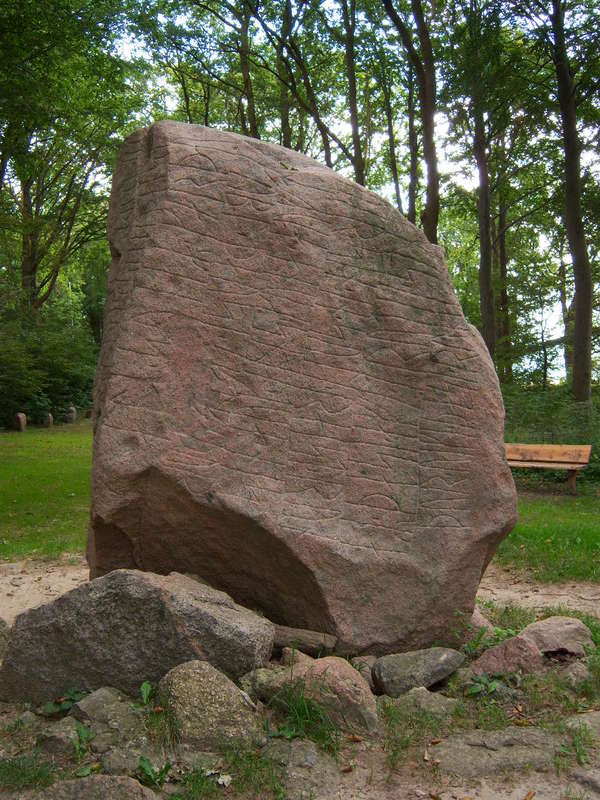 Glavendrup Rune Stone, rear view, Denmark
 Glavendrup runes inscription, translated to Danish
 Glavendrup stone ship stone #1
 Glavendrup stone ship stone #2
 Glavendrup stone ship stones 3-5
 Glavendrup stone ship stones, row #6-13
 Glavendrup stone ship stone #12
 Glavendrup stone ship, stone #14
 Glavendrup stone ship stones #15, #16 and again #14
 Drill hole, stone ship stone #17, Glavendrup DK
 Drill hole, stone ship stone #18, Glavendrup DK
 Standing stone #19, stone ship, Glavendrup Denmark
 1874 view, Glavendrup, fair use of small part of tourist explanation
 Second and artificial stone ship arrangement, for civic and other groupvceremonies, Glavendrup Denmark; later construction

 Seat stump and companion stone, Glavendrup DK.
