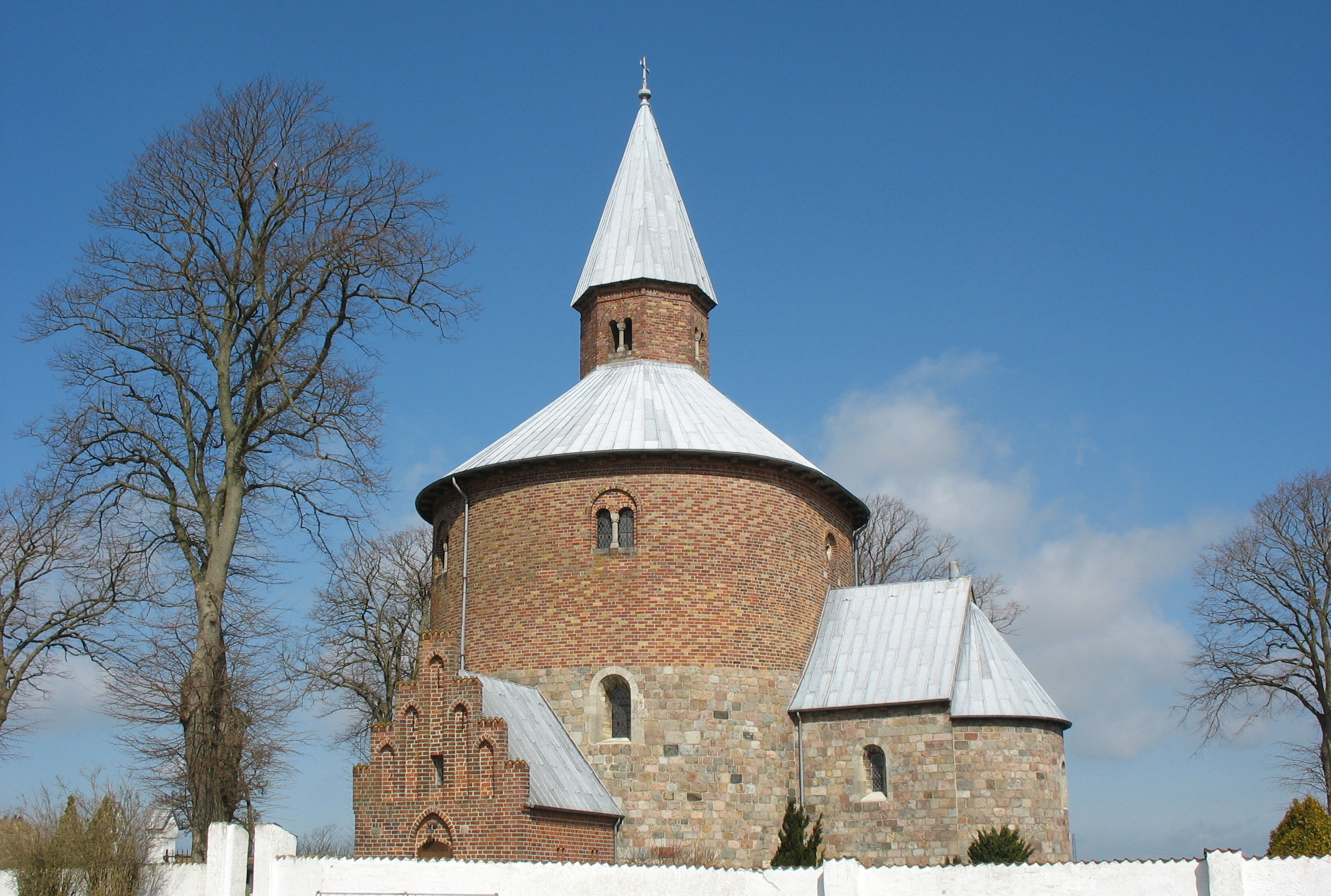
The Round Church at Bjernede, Zealand, Denmark: The Outside
Bjernede is near the town of Soro on Zealand. The round church was built in 1160, thanks to one Sune Ebbeson who was a governor to Valdemar the Great, Valdemar I. See family history at
http://medievaldanishfamilies.blogspot.com/2008/10/sune-ebbesen-bef.html.
The "bishop's hat" on top came later to the cone roof. This was the time of the Crusades, and some may argue that this was a church inspired by, or fostering, or actually used by Templars - Hospitallers, based on symbols, architectural points, see a Norwegian site laying those out, at
http://frimurertempelridder.blogspot.com/
Find a picture there of interest, of an old church (as a search for it, we looked up a Swedish "Cross Church", Forshem, there, for its Templar elements), then cut and pasted to a translator. Clicking on English does not translate the whole site at once. I cannot vouch for the site, but offer it for others' vetting. It is a site of interest either for past or ongoing Templar interests, neither or both..
1. Inscription, dedication
The inscription at the exterior door indicates the dedication: To Saint Mary and Saint Lawrence.
Lawrence? Lawrence was a martyr of 257 AD who was told to give over the riches of the church, according to a popular story; so he gave the riches to good stewards; then presented a collection of the poor and downtrodden as the real riches. Beheaded, most likely; but there is a more gory popular tale, not corroborated, see
http://elvis.rowan.edu/~kilroy/JEK/08/10.html. Why would Sune Ebbeson dedicate this building to Lawrence? So far, we see no particular connection to Scandinavian conversion. Where did Lawrence live? I believe Italy.
2. Structure
The church is a round tower, two-stories inside, open; with side transepts on two adjoining sides. The view from the front shows a clearly round church -- stroll around back and see a totally different configuration - two transepts. One looks original, and one looks tacked on. Note the upper windows, and check this site for a possible significance for the double arch. In some Templar-type churches, those line up with the sun or moon at certain times of the year, for ritual purposes. Is that so? Scroll down at
http://frimurertempelridder.blogspot.com/
2.1 Round church - not enough in itself to be Templar, but interesting possibility.
Round churches traditionally are said to be defensive structures, including Bjernede, see
Castles of God, Fortified Religious Buildings of the World, by Peter Harrison 2004,
Defensive purpose, round church structure.
- In Harrison's book, defense against the Wends is cited. But the Wends were not just another tribe on the rampage against Christian incursions. Wends were a prime target of the Pope's Northern Crusades - Crusader interests again -- see Wends and the Pope's Northern Crusades. What other purposes, if any, underlie it? Perhaps none. Still, see the history of the Wends -- the Templars or their religious army equivalents were themselves on the rampage there, see http://denmarkroadways.blogspot.com/2011/07/korsor-and-wends-highways-bypass.html. Merely citing a defensive purpose and generally saying "Wends" does not detract from a now more likely than ever Templar, or at least Teutonic Knights function or interest.
moving from Germany north to Scandinavia where the Wends were being pushed.
The round architectural style is old (Rome's Pantheon, Charlemagne's octagonal-round chapel), and came more into style for churches after the crusades. Connected to the Church of the Holy Sepulchre in Jerusalem in style, even if just as copycat possibly.
Some round churches are truly round: no transepts jutting out. What is the significance of the shape. See
http://kngdv.blogspot.com/2011/02/round-churches-roundtables-labyrinths.html.
There is a cluster of round churches on Bornholm, an island of Denmark accessible by ferry; and those suggest a Templar tradition.
- Who is a scholar here, and who is repeating wishful, adventure-thinking? See http://www.nature-spot.com/2009/03/bornholm-island-templar-churches.html. Assuming a grain of truth between the series of round churches here and in Europe, see this round church in that context: of the same era, in this early orthodox era.
- If there is a connection between those going to and returning from Crusades, from the time soon after the Great Schism in 1054, where the Roman Christians split from the Eastern Orthodox Christians; to the first Crusade in about 1065; through Rome's western Christians slaughtering even Eastern Orthodox Christians in the Sack of Constantinople in 1204 (about 35 years after this Church was built); and through the murder of the Templars allegedly completed with the burning of Jacques deMolay in 1314, and subsequent and earlier flights of Templars and alleged riches and the Grail with them, supposedly; that puts this church in an active crusading and east-west conflict period and open to those influences.
- As to Templars and crusaders going and coming, there would be a strong influence of eastern Christianity brought with them. The exposure at least was there. If Templars favored Rome's rival, Orthodox and other eastern ideas, in any way, would Rome long tolerate it? What happened to the round churches. Were they ever Templar, part of a network to safety, concealment. Enter, Hollywood.
- A Templar or other secret society connection would explain the anomaly noted at http://medievaldanishfamilies.blogspot.com/2008/10/sune-ebbesen-bef.html, that rites at the lower level cannot be seen from the upper, easily; and the upper level is also only accessible up a spiral clockwise stair, very narrow, so that noone in armor could ascend. If they did, their right arm, presumably the sword arm, would be pinned to the center of the spiral, leaving only the left arm free to wield. That was a customary defensive construct in castles and churches, and appears here. See video by Martin Pavone at http://www.youtube.com/watch?v=Our23yp8fJo
Look at the shape in that context, East and West in collision, lines not firmly drawn.
So, can we explore the shape as more than mere architecture choice. Explore the shape as an expression of a mindset of the builder, a belief system that reflect pre-Roman Church Latin or an alternative to Roman Church Latin-dominance ideas (brick Gothic expressed the Roman emerging idea, these are earlier Romanesque from an era of no division: no hierarchy imposition yet? vet the idea. See that and other historical considerations, unanswered, a theorist merely recording theory points, at FN 1. Or not.
For now, stay what is seen.
2.2 The shape of the cross
Equal-sided crosses can be the Prussian Iron Cross, that later became a symbol of Fascism; the Maltese Cross, with its inward aimed arrowheads; a sun-wheel or ring cross, see Celtic crosses; see
http://www.crossroad.to/Books/symbols1.htmlI
This church shows a theme of the Greek cross with its equal sides. See it at
http://www.religionfacts.com/christianity/symbols/cross.htm It is the most ancient cross -- ans suggests by that that the crucifixion was not central to Christianity at the outset at all. That emerged as doctrinally important later, and then the cross itself became the kind of cross that a crucifixion would probably take place upon: a long vertixal axis for the body, a shorter horizontal axis for the aris.
The equal sided cross, however, is more easily accommodated in a circular shape, so that reinforces the idea that the circular was earlier as an idea for Christianity before east and west so split, than the later Latin Roman big church with the long aisle etc. Is that so?
Door symbols here do not look Roman Catholic. This is an interior door, included here because of the cross, but also to show that closed doors, that an ordinary tourist would not touch, can hold back on so much of interest.
- This equal sided cross is not inscribed in a circle, and has two scrolly forked ends. See it and variations, called the Forked Cross, at All Crosses, http://www.seiyaku.com/customs/crosses/index-all.php?Spacing=20
- To be a Greek cross, would the ends have to be plain?
- The crux of this church, pun intended, is behind the closed doors like this one.
- Behind, we now learn, is a staircase, a narrow defensive stone spiral stair, to the upper level. See the video at http://www.youtube.com/watch?v=Our23yp8fJo
- See if you find there some more corroboration for the idea that this, like other round churches in Denmark and elsewhere, have crusader and even Templar connections.
The doors like this were all closed when we went inside, so we did not know that behind at least one was a staircase leading to an upper level where all is laid out for non-usual mass reasons.
And we had no idea we could open the doors (we hesitate to barge around) and go up.
Other people have, however,
- There are also multiple circles. Those may just be decorative; or represent, according to this site (giving both traditional Christian and other non-Christian origins) the female principle and power, sun disk, sacred hoop, unity, infinity, and gnostic elements. Scroll down to the circle at Symbols and Their Meaning at http://www.crossroad.to/Books/symbols1.html
3. Construction.
Here: What was the timing of adding the second transept? One does look out of place. Need to look up the evolution of church architecture. Sune Ebbesen began the church in granite, then switched to brick, then a new building material coming into fashion in Denmark at that time, as the techniques improved.
There are two transepts. This one, all brick with a stair-step facade, does not look "of a piece" to the main building. There is no flow to the joins. Tacked on? Did a later vestry suddenly want an entryway for the pamphlets and sign-up sheets? And a coat rack?
4. The churchyard
4.1 Burials
Who is buried where is addressed at
http://medievaldanishfamilies.blogspot.com/2008/10/sune-ebbesen-bef.html The inscriptions are not preserved, out under lichen, and hard to read. We saw no information tracts inside the building.
Our interest is in the pre-Roman hierarchy influences that are suggested by a round church, equal-sided cross. Is there ground for that interest. This one, for example, looks not like a Christian cross, but like the Sun Wheel, or Odin's Wheel. See it at this site illustrating cross shapes:
All Crosses at
http://www.seiyaku.com/customs/crosses/index-all.php?Spacing=20
This cross is inside a circle. The quartered circle, or sacred circle with equal lines pointing to north, south, east, west, is not Christian in origin, and has strong pagan roots, although it was later adopted -- particularly by Celtic Christians, think Irish. See it as the sun cross, at
http://www.crossroad.to/Books/symbols1.html. The wording on the stone is illegible, enlarge and tinker as we try with contrasts.
Found in the burial yard were some very old graves, see the
medievaldanishfamilies site above. Two men, perhaps not Ebbe? That would be a Greek Cross, except for its placement within the circle. Is that so?
The lettering shows deaths in the 17th Century. The little rectangle encloses ,
4.2 A Place for Bells
Is this a belfry? Probably not. Belfries originated as watch towers, a place to go for safety. Bells were often located there, to give warning. This garden level church bellhouse would not, then, be a belfry, but used similarly: mark the services, and even danger. See
http://www.thefreedictionary.com/belfries
Why would having bells be a "horror to the heathens?" That is said not in connection with this church, but another. See
http://www.ccel.org/ccel/schaff/hcc4.i.ii.xxiv.html See overall discussion of modern vs. old worship at
http://users.bestweb.net/~kali93/oct98/leitch.htm
5. Materials, timing, symbols.
Ebbe began in granite, ended in brick. This stair-step facade on the churchyard gate house, as to style, in that area looks new. The little bishop's hat on top of the roof, the little tower part, is very new: it was added in 1892. Adding a bishop's hat is a further way of distancing from any whiff of the Orthodox. Another equal-sided cross is suggested by the window at the top near the roofline.
5.1. Is transept the right word for those appendages?
The window also echoes the style on the main round tower. This is an amateur talking. Move closer to get the trees out of the way. The join looks all of a piece.
5.2 Practicality
A window at the end would also be needed to light up that section.
6. Eastern influences.
We assume that Rome converted all of Europe to Christianity, but that is not so. It was fight all the way. Even Constantine rejected what Rome was doing, see the Cyril and Methodius site below.
The earlier Orthodox (before there was the Great Schism) missionaries included Cyril and Methodius, in the Slavic areas to the Baltic, see
http://www.encyclopedia.com/topic/Saints_Cyril_and_Methodius.aspx; and
Ansgar, Apostle of the North, also had an orthodox background, we understand. The violence of the Holy Roman Emperors, including Charlemagne, did not get this far, but word did most likely. Do what Rome wants.
The original transept here could fit an Orthodox-slanted tradition, see
http://www.pointleb.net/directory/index.php?title=Cathedral_architecture_of_Western_Europe; that would leave for later years the need for a convenient rain-shielding entryway.
Brick peak roof addition. Fake. Take it off. This is supposed to be a round church.
See other round churches: they mostly follow an axis inside as that Greek cross, equal arms, creating an easy circle form. Add an entry and all is well. It was later that the Roman or Latin cross took over architecture, as Rome tried to diminish the influence of the Orthodox after Rome left the Orthodox in the 11th Century, is that so? But Orthodox had been at work in Scandinavia long before that, before the Schism, so a Greek cross would have been a natural.
The good guy transept, that fits; is on the right. The bad new guy, with the stair-step facade that doesn't fit, is on the left. Is that so? That is brick gothic, much later than the Romanesque of 1170. Doesn't match at all. Is there a brochure on this, or are we just wrong here? Who has the series of footprints, floor plans? Find a photo showing that odd transept more clearly, at
http://upload.wikimedia.org/wikipedia/commons/0/0c/Bjernede_Kirke.jpg
.....................................................................
This is to keep ideas in one place, not necessarily recommended reading for anyone else.
FN 1 A History aside. Look again at the meaning of the shape of the round church. Can it be seen as a protest against the hierarchy, authoritarian set-up of the Roman version of Christianity elsewhere. A nod to the other branch known to the Scandinavians through the Slavs, the Orthodox.
- What was Norse culture. Why do we patronize multi-deists as "pagan". We have the trinity -- a thinly disguised multi-deist system. They say there was human sacrifice. Was there? Was that event as bad as persecutions of Jews, Inquisitions, Crusades East and Crusades North, Witch-burnings? The Norse had a functioning centuries' old self-sustaining tradition. Where to find Christianity-history that is not an agenda, proselytizing, painting all the saints as saintly and all the men as good-looking, etc. Start with the BBC - http://www.bbc.co.uk/history/ancient/vikings/religion_01.shtml; but even that is assuming a superiority to the Christian.
Challenge the BBC. Scandinavians did not adopt Christianity easily. The first missionary came in the 700-800's. Conversion took until about 1200 for Scandinavia. BBC, even your account is rosy false. How can that be? Where is your narrative of Charlemagne against the Saxons; and the Northern Crusades.
- Needed as we wind down this great (to us) trip to Denmark: A neutral statement of the multi-deist culture of the northern people: how were they worse than the Inquisition, the persecutions, the witch-burnings, etc? We need a good norse advocate. What did they gain by conversion except entry into the dubiously "superior" world of moneymaking and powergrabbing by making churches into institutions. They had a more egalitarian culture than ours, did fine. Is that so? It was merely force and not merit, that turned the tide.
So, when there is a round church, that suggests ties to the oldest Christian roots and ideas of egalitarianism, might that have come through an early church Orthodox influence, before the Great Schism? Or is it happenstance. Nobody seems to know. See
http://www.metmuseum.org/toah/ht/?period=06®ion=eue
What is Orthodoxy had won over Rome instead of Rome prevailing over the rest of Europe? Rome had militance and administrative skills; and the exclusions of Mithraism (no women allowed). Paul's home town was a center of Mithraism. None of that is merit in belief. That is force.
- Was there an influence of the Orthodox in the 12th Century in Scandinavia, or at least a hesitation in adopting everything Roman. Round churches fostered either the informal service of the earliest times, in the round; or providing with the transept a place for the iconostasis, where parts of the service took place away from view. The Orthodox had been in Scandinavia, Cyril and Methodius' ideas including services in the native language (hated by Rome) came up through the Slavic areas of the Baltic, and had at least some influence until the Pope's Northern Crusades 1231-1282 or so (see http://militaryhistory.about.com/od/timeline/a/1300s1400sTimeline.htm).
- Why the aversion to the West? It appears that the Viking raids on Christian monasteries began not long after Charlemagne's slaughter of the Saxons and forced conversions of other Holy Roman Emperors. Scandinavia wanted no part of this religion. Who wouldn't lash out? See the dates outlined and connection suggested at http://forums.skadi.net/showthread.php?t=76590. So Western Roman Christianity in that sense asked fo r it. They started killing off any who would not convert, or re-convert if they had been already Christianized by the Orthodox, according to Rome's standards. See Charlemagne in the Saxon lands: word spread.
- And it got worse, with the Northern Crusades. Any Prussians targeted by the Teutonic Knights, for example, were already Christian -- converted by the Orthodox. But this site does not mention that, see http://www.crusades-encyclopedia.com/thenortherncrusades.html; this one does, and heavily (properly so) see http://www.conflicts.rem33.com/images/deut/drang.htm.
- See also timeline at http://www.christianitytoday.com/ch/1999/issue63/63h028.html
- The Greek cross idea of equal distance between worshippers and whoever led the service, also in the early church had signified the equality of all before God, men, women, rich, poor -- as J himself had practised. The Latin-Roman sect after the Schism with the Orthodox changed architecture and doctrine that entrenched a hierarchy idea in Christianity -- the Roman or Latin cross with its huge vertical axis, and little horizontal.
 Christian August, 1st Bishop of Lubeck 1673-1726
 Claes Brodersson Ralamb as shown in (we understand) the Nordiska Museet in Stockholm, brown wig, Swedish diplomat, 17th Century
 King Christian II, farewells, on way to imprisonment at Sonderborg Castle 1538-1555
 Tower, prison, Sonderborg Slot, DK
 Sonderborg Castle, Denmark, airy soldiers' billet,
  Sonderborg Castle, DK, billet cooking smoke hole, rampart grounds
  Large receptacle with press, rotator. What? Sonderborg Slot, Denmark
 Soenderborg Slot, DK. Renovation blocks the cannon.
 Sonderborg Castle, water supply well or oubliette? Escape hatch?
 Military uniforms, 19th C, Sonderborg Castle DK
 Bjernede Rundkirke, Round Church, exterior, near Soro, Zealand, Denmark
 Sune Ebbeson, patron builder tribute, Bjernede Kirke, DK
 Fork cross doorway design, interior Bjernede Kirke, DK. Behind door, a stone defensive spiral stair to upper regions.
 Bjernede Round Church, transept looks later. Soro, DK. Bjernede Kirke
 View from Bjerjede Runekirke churchyard to thatch-roof cottage, near Soro, DK
 Grave, Bjernede Rundkirke, DK Flat, elevated stone with illegible inscriptions
 Churchyard memorial, Bjernede Kirke, Round Church, DK
 Sun cross or Odin's Wheel? Bjernede Churchyard, DK
 Inscription stone, placed on wall,churchyard, Bjernede Round Church, DK. Bjernede Kirke
 Grave marker enlarged, Bjernede Churchyard, 17th -18th C deaths, DK
 Bell shelter, Bjernede Round Church burial ground
 Bells in bellhouse, Bjernede Rundkirke, DK
 Churchyard, brick gothic Gate in wall, Bjernede Rundkirke, Zealand, DK. Bjernede Kirke
 Transition from granite to brick, transept looks original, Bjernede Rundkirke DK. Is it? Bjernede Kirke. Near side, rear view
 Granite transept, near side view, Round Church at Bjernede DK. Bjernede Kirke
 Far window on transept also looks original, Bjernede Rundkirke, DK. Bjernede Kirke. Near side view.
 "Bishop's hat" on round tower, near side view, Bjernede DK. Bjernede Kirke, Bjernede Rundkirke
 Bjernede Kirke. Odd-looking transept, stair-step facade. Who put that on? Bjernede Round Church getting less round with the years.
 Far side view, granite transept. This one looks good. Bjernede Rundkirke, Denmark. Bjernede Kirke.
 Where the granite becomes brick - later brick gothic transept blocks and ruins the style.
 St. Mary's Cathedral, Ribe Denmark
 Romanesque arch, St. Mary's Cathedral, Ribe, DK
 Iron door, St. Mary's Cathedral, Ribe, Denmark
 Adam and Eve, St Mary's Cathedral, Ribe, DK
 Memorial plaque, death imagery, burial, St. Mary's Cathedral, Ribe, DK
 Three benefactors, or is this a burial? St. Mary's Cathedral, Ribe, Denmark
 Adam and Eve, still androgynous in many ways? St. Mary's Cathedral, Ribe, Denmark
 Rroslev Internment Camp, Jutland, DK. Guard tower.
 Froslev Internment Camp DK, sand pit work area, Jutland, DK
 Memorial, Froslev Internment Camp, rebellious inmate sent for further "disposition" through Theresienstadt CZ and elsewhere.
 Layout, Froslev WWII Internment Camp, Jutland, DK
 Froslev Internment Camp, renovated for Youth ad other use,
  Renovated inmate barracks, now arts and youth uses, Froslev Internment Camp, WWII Jutland, Denmark.
 Guard tower view, Froslev Internment Camp, Froslev, Jutland, DK
 Memorial Frpslev Nazi Internment Camp, Jutland, Denmark
 HItler puppet caricature, Froslev Internment Camp, Froslev, Jutland DK (fair use)
 Puppetry caricatures, Nazi officials, Froslev Internment Camp, Jutland, DK, WWII
 Nazi head in sand cartoob fair use, Froslev Internment Camp, Jutland, DKi
 Danes as Warriors, for Denmark and Others, Exhibit portion, Froslev Internment Camp, Jutland, DK
 Danes in uniform serving humanity's causes, fair use, Froslev Internment Camp exhibit, DK
 Stove for barracks, Foslev WWII Internment Camp, Jutland, DK
 Frpslev Museum, Internment Camp during WWII, Jutland, KK.
 Froslev Internment Camp, WWII Jutland DK. Crowded, severe. but not life-threatening in itself.