Scrub, scrub, scrub the history.
Dig Deeper; and Admire the More.
Hans Christian Andersen grew up in poverty, hounded by his difference, targeted as well as ignored, seeking relationship, homely, ungainly, lonely and frustrated. His was a hardscrabble family, but he found his way from pillar to post, this benefactor to that benefactor, from time to time, just enough to keep going, and have his art recognized. Read the unsentimental biography,
Hans Christian Andersen, The Life of a Storyteller, by Jackie Wullschlager, the Financial Times art critic.
What was the orientation of Hans Christian Andersen, and does it matter? Obviously it does, because finding information that relate in that direction takes some digging, and going beyond Wiki. Try his relationship with Harald Scharff, at page 376 plus or minus, at ://books.google.com/books?id=SZ50_q-diBwC&pg=PA379&lpg=PA379&dq=Harald+Scharff+and+Hans+Christian+Andersen&source=bl&ots=me-0xbM1QU&sig=wsW-zXFkyrHUqn5yQPuYdR2bHFE&hl=en&ei=9RS_TIj8G8G78gaIkPW8Bg&sa=X&oi=book_result&ct=result&resnum=3&ved=0CCMQ6AEwAg#v=onepage&q=Harald%20Scharff%20and%20Hans%20Christian%20Andersen&f=false / Scharff was a ballet dancer with the Copenhagen Royal Ballet, see ://shop.cosis.net/bookstore/book/3471013/0/COST/BOK/EN9786130838256/HARALD_SCHARFF.html?PHPSESSID=b923627b0b6d46f0173a1baf302f89aa/; and Karl Alexander August Johann, Grand Duke of Saxony, etc. Unrequited, requited, pendulum swings to unrequited, but our interest is only in the fact that feelings are human and why must we pretend in our cultures and to our children.
Check the original photos and accounts against the Disney-caged worldview. Admire the gift. Accept the original lifestyle. Why should Disney, and the rest of us, hide reality.
I. Hans in the Square.
An idealized face, for a homely man.
Hans Christian Andersen sits at a highly visible place at the town square. Now see the same basic photo a few minutes later:
A shopkeeper added a second head of Hans, half a head, at Hans' toes. It ruins everybody's picture; and all to lure a few tourist-Kronor into the saucer under the chin of the head. Snap your wallet shut, O Tourist. Where is the town council when you need them?
Still, we took the picture. Moral: Get to the Square early for your picture. The disembodied half-head is too heavy to move with your foot, out of the lens view. Paying street performers via their hats on the sidewalk is one thing. An interloping free-loading shop-keeper is another. Is there something here we are missing?
II. Hans at Home
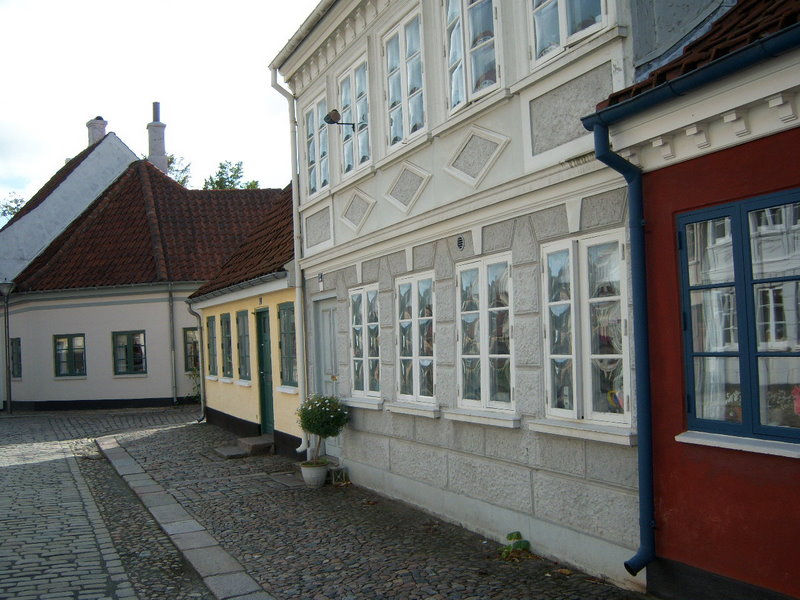
Here is the street where Hans Christian Andersen was born. It is expanded into a museum now, with the museum entry behind, and a garden, and large addition at the back that is not seen from the street. Find the museum at this fine site -- ://www.galenfrysinger.com/denmark_odense_anderson_museum.htm/ The site alludes briefly to the lifestyle. Appropriate also not to let that become a focus, when the art is so fine.
Then refer to reality. From this cute setting, use your imagination for the filth around and despair of early 19th Century poor. Hans Christian Andersen told tough stories. Children can take it. Let them in on the secret here. Add some text or photos of real 19th Century slums, to help educate our children. Good things can come in conflicted packages, from demeaning sources.
Hans Christian Andersen hus. The Yuppie setting again.
III. Hans in real life could teach us much more.
Bucolicism does us all a disservice by re-making history. We are only taking pictures of stage sets. Why not set up a stage set of a real slum from the times? Why teach fakery to children. Agenda over truth.
IV. Hans Rumor
An Odense resident told us as we walked to the square that there have always been rumors that Hans was the son of the King, and that his mother received money from the King throughout her life. Given the Wullschlager biography, that seems hardly likely. Still, read this lesser-known story by Hans Christian Andersen from 1853,
Everything In The Right Place, at ://hca.gilead.org.il/right_pl.html/
V. Hans online
Read some of the tales now, before you forget. Click back and forth at the Gilead site, and read more stories by Hans Christian Andersen How long has it been?
 Hans Christian Andersen, later childhood home, half-timber, brick-fill, Odense DK,
  Odense DK, street scene, Hans Christian Andersen later childhood home
 Odense street leading to river, Denmark. Hans Christan Andersen's mother washed clothes there
 Busybodies on windows, Odense Denmark
 Odense DK, busybodies installed on windows
 Hans Christian Andersen #1, sculpture, Odense Denmark
 Hans Christian Andersen #2, Odense DK. Now with two heads.
  Hans Christian Andersen #3, with admirer despite the two headed Hans. No way to get that foolish money head out of the picture.
 Hans Christian Andersen: born here, Little Yellow House, Odense DK
 Odense Denmark, Hans Christian Andersen birth home (now polished)
 Hans Christian Andersen, early childhood street