Friday, July 15, 2011

Kalundborg - Church with Five Steeples; Theological and Economic Symbiosis; Stork Roof Symbiosis


Kalundborg:
Economic or Industrial Symbiosis
Steeple Symbiosis
Roof-Sharing Stork Symbiosis

Kalundborg. A 12th Century town on a harbor (west coast of Zealand, Sea Land, Sjaelland, can't spell that, so back to Zealand), that fosters 21st Century multi-faceted use of its properties.


1.  Economic Symbiosis. Industrial Symbiosis.

Economic or Industrial Symbiosis:  This concept means that a community of commercial interests, businesses, locate at the same property.  They collaborate on use of the environment and resources, and produce "enhanced environmental, economic, and social performance."  See Kalundborg and its Economic Symbiosis at http://www.eoearth.org/article/Kalundborg,_Denmark.

The drive for common sense started in 1961 with a collaboration to preserve Denmark's precious groundwater (it and its islands are surrounded by salt water), and use instead lake surface water through a pipeline and purification system, and several economic interests contributed to the project to their mutual benefit. See uses of waste products at http://www.thefreemanonline.org/featured/regulatory-roadblocks-to-turning-waste-to-wealth/. This is all for the benefit of later generations, as the groundwater was not used. See also Dollars and Sense: Denmark Shows the Way. Kalundborg

Good idea.  Read and learn - economic symbiosis. Industrial symbiosis.  More at a regional site, http://www.baltcica.org/casestudies/kalundborg.html.  Could it work somehow for natural gas fricking fracking here?

2.  Steeple - Saint Symbiosis. Church of Our Lady

This means that a community of multiple steeple interests, deity invocators, locate at the came church.  Collaborate on airspace and produce an enhanced steeple experience.  Find it at the Church of Our Lady.  Count them:  1,2,3,4, and there in the back, peeking out and pointing dutifully up, 5.


Enjoy the hedge-maze landscaping. The covey of gardeners will watch you pass, and smile and nod when you do. Don't hesitate to be first.

Each tower one is named for a saint, and as was common in Scandinavia before Rome decided enough attention to women was enough, and the men had to take over prominent positions instead to be true to the Doctrine they pushed,  they are named for female saints:
  • St. (Virgin) Mary's in the center, 
  • then east to St. Anne, 
  • south to St. Mary Magdalene, 
  • west to St. Catherine. 
 You know the Virgin and Mary Magdalene, and St. Anne, mother of Virgin Mary.
 
St. Anne does not appear in the New Testament, however, we learn; and only is in the Apocryphal literature, James' Protoevangelium, or Protevangelium.  She was much venerated in the Middle Ages but not until the 13th Century.  Also find her as Anna. Spend time with her role, see St. Anne, Anna, Mother of Mary, James' Infancy Gospel
That means she would be a newcomer to the devotions. She must have made an impact on the faithful, because at that early stage of European focus, she had a steeple tower named for her.

Catherine? That could not have been the Italian Catherine of Siena, who lived 1347-1380.  It could have been St. Catherine of Alexandria, greatly revered in the Middle Ages, a scholar a beauty and a martyr, but Orthodox and historicity may be questioned, see that quick look at Wikipedia.

It takes time to get all the steeples in at once.  Getting closer does not help.

The church architecture is an equal sided Greek cross, with a steeple also in the center, making all the steeples feasible and equal.

 
The town, began in earnest as a trading center in 1170, and once looked like this model.  The church tower-tower-tower-tower-tower towers high. Do they all have bells?  Do they ringbongclangringbing in sync? 


The model of the town is a fine use of church yard space at the Church of Our Lady. 

Note there were many towers in the town, in the town. There (2-3) were towers in the town, in the .....

Watch it.

In Denmark and we find in most of Europe, you will not see protective railings around depressions in the ground.  You are expected to watch where your own feet are going, and not fool around with your companion.  A careless stumble into this little model would produce some nasty gauges, so be careful. Don't expect to sue. That's what your eyes are for.


3.  Stork-Roof Symbiosis

This means that the stork population may want to use the same roof as humans, and should be allowed to do so.  Find this one and look closely to see that the nestic construction is not a continuation of the treeline behind the roof.

That is a European White Stork nest, followed up on the ridge line by wise footholds for little storklets and storklings (females and males) to cling to when time to fledge. In some places, the roof owner will construct a wooden frame to make the nest secure, see Ribe.
,


Rural DK: Windmill, Burial Mound, the Flats

Me and My Son In Our Automobile

1. Windmills.

The wisdom of the windmill. How a windmill works. One kept in good repair lasts centuries. Whoompa. Whoompa. In the old days, the whole family could live inside. To adjust the whoompa, jam in the log brake to stop it. without bisecting yourself, and adjust the fabric covering, or take it off completely.  See more at http://www.edinformatics.com/inventions_inventors/windmill.htm


2.  Burial Mounds.  

Northern Fyn is flat, and these occasional mounds stand out.  This one is Marhoj, or Marhofte. Translating sounds from one language to another leads to a variety of letters and little consistency. Research all variations.

Its inner chamber has long been emptied; these mounds never held great riches, but someone was always hopeful. See http://www.visitdenmark.com/island/is-is/menu/turist/oplevelser/attraktioner/produktside.htm?CallerUrl=1&Id=002412&print=true


The marker, we now think, means you can go on the private property and up the gully to inspect closer. We had the page of Danish road signs, see http://www.trafikken.dk/wimpdoc.asp?page=document&objno=20853#Special but that one was not on it. You go. We found somebody's website on it later, and the inside looks routine.  Denmark and Sweden: neither go out of their way to direct tourists. People are friendly and helpful, but little budgeting is done to see that the places are noted and visited.

How old?  We vote for 500-1000 CE. Broad range and it gets broader.

We found sites describing these kinds of graves, burial mounds, as Neolithic, Stone Age. Learn some archeology and timelines, and find that Neolithic means 3900-1700 BC in Denmark, and Stone Age is part of that. See http://oldtiden.natmus.dk/udstillingen/bondestenalderen/language/uk  

Those on the oldtiden  site, however, look too old to be like this: they are more like dolmens, upright stones with a capstone, or barrow graves with entryways.  Nut not as big as these mounds. 
 Keep looking: This one also says that Marton is Stone Age, however. See http://www.travelpod.com/travel-blog-entries/sarahindenmark/denmark/1189981800/tpod.html. 

Our amateur vote goes with Viking era for these, 800-1050 CE or so; or at least not before 500CE. Still looking.

3.  Wind blows free


Rural areas enjoy good roads, one lane or two. Slow up, pull over, room for both.

Marguerite Route.  

You can always take the prefab Marguerite Route in Denmark, to see all the foreordained sites, see http://www.visitdenmark.com/international/en-gb/menu/turist/oplevelser/attraktioner/sightseeing/the-marguerite-route.htm.  Or use it as a sequencing device, if you do not have the time to see every inch of Denmark.   The full map is at http://www.visitdenmark.com/international/en-gb/menu/turist/kort/kort/map-of-denmark.htm.  We rambled instead.

Wednesday, July 13, 2011

Glavendrup Part II: Tryggevaelde. Rune Stones. Ragnhild. The Holes in the Stones. Torghatten.

Glavendrup Part II
Meaning of Drill Holes in Rune Stones
Search for Ragnhild, who erected the Stones.

Stone Ship Site:  Ragnhild honors Husbands Alle and Gunnulfr
Part I at http://denmarkroadways.blogspot.com/2011/07/glavendrup-viking-stone-ship-ragnhild.html

Update: August 3, 2013. See 4.7 below. Is Ragnhild's use of drill holes in the stone ship standing stones also to signify her origins in Norway, area of the distinctive Torghatten rock formation with its tunnel hole on Torget Island, Norway, once an area of the Nitherians, Nidaros?  Scroll down for this latest entry, the Torghatten rock connection, possible.

 Ragnhild erected a stone-ship Glavendrup, 
 rune stones including Tryggevaelde with many drill holes, at the Danish National Museum, Copenhagen.

Two remain at Glavendrup with solitary drill holes.
What do they mean? 


Then read the comment, with yet another possibility.
.....................................................................
 
I.  Ongoing Mystery I. 
Holes in Stones at Glavendrup Stone Ship Site
Why, Ragnhild?

1.  Who is Ragnhild. See her stone ship in Denmark at http://www.vikingdenmark.com/glavendrup-stone-ship-runic-stone-funen-denmark.html.  The date is given as early 10th Century. 

Ragnhild is a woman of the Scandinavian Viking era, 10th Century. She is a person of means, who can afford not one but two rune stones and at least one stone ship for her husbands, that at the same time pay deserved tribute to herself for doing it. I did this. Good for her. She erected Glavendrup rune stone for Alle, a priest and clan chieftan.  She erected Tryggevaelde rune stone for Gunnefi, a "clamorous" man.

Pronounce Ragnhild as "Wrong-heel" says http://forum.wordreference.com/showthread.php?t=644001.  

Name itself.  The name itself, Ragnhild, has come down to us as "regin" for advice, and "hildr", for battle.  Ragnhild is no mere domestic goddess, the the shadow of the other.  See http://www.behindthename.com/name/ragnhild  If a woman is wealthy and powerful, this elaborate setting demonstrates that she can show it. Was there polyandry at that time? Or was this a more modern sequential monogamy, after casting one aside; or widowhood.

This stone-ship formation is at Glavendrup, in the woods. See it at http://denmarkroadways.blogspot.com/2011/07/glavendrup-viking-stone-ship-ragnhild.html There are two stones there with holes drilled through at top, to the side.  A third, Tryggevaelde, is in the Copenhagen Museum, and we did not see it.  See it at FN 1, Wikimedia Commons. The holes are unexplained.

2. What is the meaning of the drill holes.

At the Glavendrup stone ship site are two stones with drill holes:  Here, the first, with a front view of the stone hole. 


A second stone ship stone, same location, shows the hole off to one side, and a vaguely heart-shaped drill hole. 


Be still, heart.

The heart shape means courage in the old symbolism, the heart as the seat of courage, warlike virtue. See http://rua.ua.es/dspace/bitstream/10045/10394/1/RAEI_21_03.pdf.  This stone bears some resemblance to the heart, but beyond that, we cannot go.  There is a modern stone erected to Ansgar, Apostle of the North, with a heart also on it, see the Glavendrup Part I site.


3.  Who were the people commemorated.

Parse the runes and the meaning so far.  They tell us she has relatives, and was married, at least two times.
See inscription and  http://en.wikipedia.org/wiki/Tryggev%C3%A6lde_Runestone.

Soto carved the runes.  Who is Soto?  A slave? A superior?
  • Stone 2:  Tryggevaelda, now at the National Museum of Denmark in Copenhagen, see FN 1, and erected by Ragnhild to honor, as written in the runes,
    • another husband, Gunnulfr, who was
    • a "clamorous" man. 
    • Ragnhild is the sister of Ulfr.  
    • Gunnulfr is son of Nerfir. 
Tryggevaelde, rune stone erected by Ragnhilde, drill holes, now at the National Museum of Denmark at Copenhagen:  Wikimedia Commons.


Nationalmuseet [CC-BY-SA-3.0 (http://creativecommons.org/licenses/by-sa/3.0) or CC-BY-SA-3.0 (http://creativecommons.org/licenses/by-sa/3.0)], via Wikimedia Commons
Rune-carver Soto carved the runes again.  What would the status be of a rune-carver? Another rune-carver of a rune-stone, but in Sweden, did his work for his master, so perhaps this Soto is also a slave. See http://swedenroadways.blogspot.com/2011/02/anundshog-viking-burial-mound-at.html

4.  Search for Ragnhild.  Several stories of other (some same?) Ragnhilds

4.1  Was this the same Ragnhild, daughter of Hakon who was King of the Nitherians?  Here is the old historian Saxo's account of Danish history-myths. 

4.1  Was this Hakon the same as one Hadding.  Similar spellings, sounds.  Hadding.

Hadding is a hero. He is said to be called "Ing" by his people, see http://www.sacred-texts.com/neu/tml/tml14.htm
[The King Inge buried at Vreta Kloster in Sweden?? See http://swedenroadways.blogspot.com/2010/12/linkoping-berg-burials-at-vreta-kloster.html]. He may also be Hadingus, see http://en.wikipedia.org/wiki/Hadingus

"Hadding chanced to hear that a certain giant had taken in troth Ragnhild, daughter of Hakon, King of the Nitherians; and, loathing so ignominious a state of affairs, and utterly abominating the destined union, he forestalled the marriage by noble daring. For he went to Norway and overcame by arms him that was so foul, a lover for a princess."

Fair use, Saxo, see http://omacl.org/DanishHistory/book1.html;nsee also http://www.vildbabel.dk/viking/saga/saxo/book1.htm

Hadding and the Nitherians are also in Investigations into Germanic Mythology, by Viktor Rydberg, see http://www.germanicmythology.com/ugm1/UGM1NEW44-95.pdf

The story continues, with perhaps an explanation of the hollowed holes like ring holds in the stones:  

Ring tale.  Here, Ragnhild and the ring story --
"For he thought so much more of valour than of ease, that, though he was free to enjoy all the pleasures of a king, he accounted it sweeter than any delight to repel the wrongs done, not only to himself, but to others. The maiden, not knowing him, ministered with healing tendance to the man that had done her kindness and was bruised with many wounds. And in order that lapse of time might not make her forget him, she shut up a ring in his wound, and thus left a mark on his leg. Afterwards her father granted her freedom to choose her own husband; so when the young men were assembled at banquet, she went along them and felt their bodies carefully, searching for the tokens she had stored up long ago. All the rest she rejected, but Hadding she discovered by the sign of the secret ring; then she embraced him, and gave herself to be the wife of him who had not suffered a giant to win her in marriage."

http://www.vildbabel.dk/viking/saga/saxo/book1.htm

But no Hadding is listed on the stone.  See The Danish History - no names there except for Ragnhild. 

The story of a ring seems to be alive, because the coat of arms of the Rinkerike Commune, an area south of Trondheim, inland, shows a gold ring and red ground.

Ringerike Coat of Arms, Norway.
https://commons.wikimedia.org/wiki/File%3ARingerike_komm.svg

That is said to be a modern granting, but the old story also rings true (intended) See http://en.wikipedia.org/wiki/Ringerike

The then King of Ringerike was father to Ragnhild Sigurdsdotter, later mother of Harald Fairhair. If this were the same Ragnhild, surely the Danish Glavendrup tradition would have included it.

4.3  Is Ragnhild in this speculative alternate angle on the Hadding story.
  • Perhaps Raghnild, in her gratitude for deliverance by Hadding the Hero from the proposed marriage to the giant, sewed a ring in one of Hadding's (the hero's) wounds, so it left a mark on his thigh, and she then could feel it later and find him. That would make the "clamorous" man, Gunnulfr, on whose rune stone as husband is the ringmark, her heart's delight?  But this story would reflect not so much on Alle, because the holes on the the ship stones are not on his rune stone.

4.4  Do the husband's names enlighten the Ragnhild story.  Alle.  Gunnulfr.

Check again on the husbands.

Look for husbands Alle or Gunnulfr, a sister Ulfr, Gunnulfr son of Nerfir. Those do not appear in the Saxo Danish History, or anywhere we can find so far. Try sites: Medieval Danish Families --  http://medievaldanishfamilies.blogspot.com/2010/08/hakon-jyde-1131-ragnhild-daughter-of_20.html .

Hakon:  date given as 1131, but that and other names do not fit?


4.5.   Ragnhild is not an unusual name.

The name Ragnhild is common, but none seem to fit the story -- http://home.comcast.net/~homerbjames/HBJ/V01/V01_NorthSeas.htm

4.6.  Was Ragnhild, then, an illegitimate daughter of Haakon? But other names do not fit. http://fmg.ac/Projects/MedLands/NORWEGIAN%20NOBILITY.htm

UPDATE AUGUST 2013. 

4.7.   Ragnhild as Norwegian, a daughter of the Norwegian Haakon - Hadding - Hakon, King of the Nitherians.

a.  Nitherians.  From the name, a warlike people.  The word means to put down.  See The Dialect of Cumberland by Robert Ferguson.  A stone at Glavendrup declares that she is the daughter of Hakon, King of the Nitherians.  Was she from there? And/or her husband?

King Haakon lived 935-960 in a time of multiple kingdoms in Norway, and he tried unsuccessfully to convert his realm on the coast. See A Brief History of Norway at http://www.localhistories.org/norway.html.   King Olav, 995-1000 did complete a conversion of the coast, and there is a Nidaros Cathedral at Trondheim, also known as the Cathedral of King Olav, see http://www.visitnorway.com/en/Where-to-go/Central/Trondheim/What-to-do-in-Trondheim/Attractions-in-Trondheim/Nidarosdomen-Cathedral/ who died in the 11th Century at the Battle of Stiklestad.  It is a place of pilgrimage, once it became Christianized.  Construction began about 1070.

b.  Nidaros:  semantically similar to Nitherian, in a place and time of runes, histories by others and not the people themselves. Is that so?

Haakon IV ruled 1217-1263, a time too late to be related to Ragnhild.

c.  Are the solitary drill holes suggestive of the place from where the deceased came, or from where the erector of the stone came.   There is a distinctive such rock formation hole north of Trondheim, on Torget Island.  Do a map search.

  • See a nearby huge rock formation at Torget Island, known as Torghatten, in Bronnoy, Norway.  Now look back at the rune stones with the drill holes.  Then go to old stories, local legend.  It is said that a princess refused to marry a horseman.  He became maddened at the rejection, and tried to shoot her with his bow and arrow.  The king, however, distracted the angry suitor and threw his big hat so that the arrow pierced it instead of the princess.   Torghatten, the hat-shaped mountain, is the vestige of the tale. Believe.
See Explore Torghatten's Legendary Hole, http://www.gadventures.com/travel-news/arctic/explore-torghattens-legendary-hole-800776487/  We are going to Norway this summer, if current travel warnings abate, and hope to see this for ourselves. 


Wikimedia Commons:  http://commons.wikimedia.org/wiki/File%3ATorghatt.JPG
By Sondrekv (Own work) [Public domain], via Wikimedia Commons

So:  this idea does not shed light on Tryggevaelde with its many holes, but it may as to the solitaries.

4.8.  Dates here are different, 818 BC for this fair use snippet from a family geneology, http://thestebbins.com/

Hadding King of Denmark (m) Princess Ragnhild (d) King of the Nitherians had Princess Ulfhild who (m) Scot and founded the Scottish name and had Frode King of Denmark and had Princess Swanhwid who married Regner the King of Sweden.

So:  experts, please take over. 

..............................................................................
 

Tuesday, July 12, 2011

Glavendrup Part I - Viking Stone Ship. Ragnhild; Commemorative Stones

Glavendrup Part I.  

Glavendrup is an archelogical monument north of Odense, a little west of Otterup. It is a fine Viking era stone ship and rune stone, back in the woods.  There is also a less apparent barrow, or burial mound.  It was constructed by one Ragnhild, for her husband, Alle. See more of Ragnhild at Glavendrup Part II.

The symbol with the four-square loops means an attraction or monument. Follow them and hope.

The stone ship and stone date from the 10th Century and looks interesting. This is off the usual track, but surely worth a country drive. Remote, one lane road, if everything is gone when you get back, or the Beast slips up the path after you, life is tough.


The barrow burial in Scandinavia: Put the body in a circular depression, on stones, and cremate it.  Cover the remains with more stones, and layers of turf, to make a tumulus. A hill-size tumulus may have an opening (later opened?), others have no visible entry place. In other countries where barrow burials were common, the body was buried under the tumulus without burning, but the Scandinavian countries followed Odin (Odin: Sweden, Scandinavian Origins of a People real person in a real migration, a Sigge Fridulfson or some such who took the name Odin, or a deity manifest, or both?).

Trust the fates, leave your car hanging out there, and head up the long path with no end in sight


The crematory burials: fair use of a snippet of the Ynglinga Saga, Norse oral histories and stories written down finally by one Snorri Sturulson, poet from Iceland, in 1255.  This Heimskringla part relates the tales of the ancient Norse kings and their accomplishments, see the section numbered 8 --

"Odin established the same law in his land that had been in force in Asaland. Thus he established by law that all dead men should be burned, and their belongings laid with them upon the pile, and the ashes be cast into the sea or buried in the earth. Thus, said he, every one will come to Valhalla with the riches he had with him upon the pile; and he would also enjoy whatever he himself had buried in the earth. For men of consequence a mound should be raised to their memory, and for all other warriors who had been distinguished for manhood a standing stone; which custom remained long after Odin's time."
http://omacl.org/Heimskringla/ynglinga.html

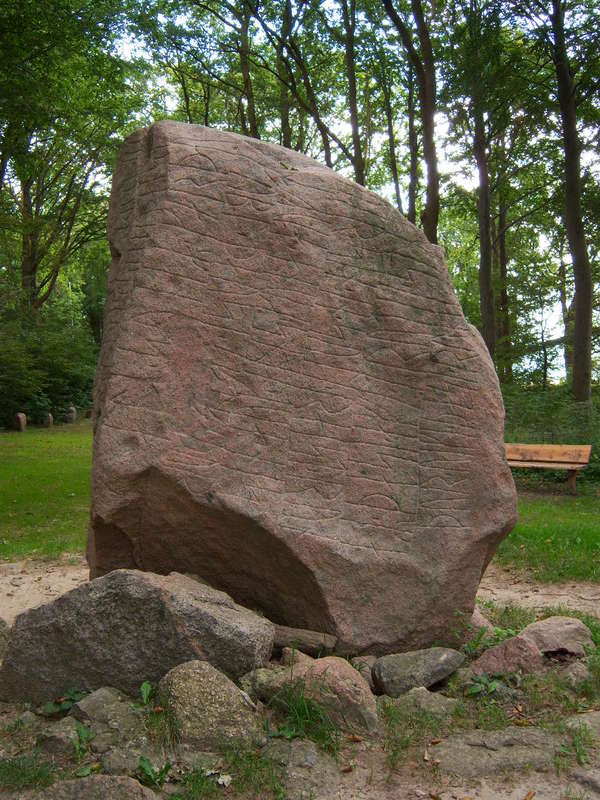
Ragnhild. It was Ragnhild who erected the runestone at the head of the ship, and added a curse at the end. See http://www.vikingdenmark.com/glavendrup-stone-ship-runic-stone-funen-denmark.html

Ragnhild.  A Viking lady of means and drive. She erected another rune stone for another husband, Ganulf; and that one is said to be in the museum in  Copenhagen, see the vikingdenmark site.


A stone ship is standing stones erected in the shape of a ship, with a memorial marker usually to one side.  It is not always an actual burial site.  See the plan. It is clear by the ages of the components that the grave is not that of the person memorialized by the runestone at the left, but a far older barrow grave is there, Bronze Age, on the plan to the right. A little hard to follow. The rune stone here should be placed more to the left, to be in its original location; without that particular mound in front of it. The site has been  "improved".


The setting was discovered in 1794, and saved from a recycling stone mason in 1808.


Where is the tumulus for the Bronze Age barrow burial?

On to the Rune Stone:  three views, same stone.


The text on the rune stone:


The text is the longest on any Danish rune stone, 210 characters, and reads:

"Ragnhild placed this stone in memory of Alle, priest of the Soelve, honorable clan chieftain. Alle's sons made these runes after their father and his wife after her husband. And Sote carved these runes in memory of his master. Thor hallow these runes.  To a 'something you do not want to become ' become he who uses violence on this stone or drags it away to stand in memory of somebody else."

Spend time with the individual stones.

To the fey among us, it soon appears that they are conversing, watching.  An imagination is a good thing.

Our numbering of stones is arbitrary and for our own identification, and not based on placement. Start with the one with the eye.


Move on to the puzzled stone.


There is an integrated cluster of listeners. And, for the curious, Denmark is very much an integrated country and addressing the same kinds of immigration-assimilation-ethnic identity issues as any other country in transition to a global-people world.


This side looks too artificially lined up.
#


The bare minerals blush stone. Are those drilled impressions, or just lichen?


Are those drilled impressions? These are in a line, part of an original drill pattern to split off this from a larger stone, or with meaning of their own.


Circular impressions.

The three circular areas on the stone look intentional.  Part of a splitting off process from a larger stone?  Or is there a resemblance related to the three circular areas (with dots in the middle) in patterns also on this representation of a Viking man's head.  This head in the pointy helmet is shown on the Glavendrupexhibit there. 

There are three more circular areas with a dot in the center, along the browline of the helmet, and possibly more.  Shield representations? Rank?  The Vikings had a "vibrant culture" of their own, so no element should be ignored as meaningless. See http://britishbattles.homestead.com/files/europe/baltic/denmark/danskhistoria.htm. 


 Their symbols, then, had meaning - as to these, what?  
  • Small linear symbol.  The linear symbol to the right with the radiating lines like legs at each end could be an element of a runic charm, an Aegishjalmur simplified, for a "helm of awe", or a Vegvisir for runic compass, both using this element Algiz or Elhaz (all this from a totally reliable scholarly site, for tattoos, at http://www.sunnyway.com/runes/tattoos.html). 
  • Circle with dot.  Here it is!  A circle with a dot in the center is a circumpunct, see Symbols and their Meaning at http://www.crossroad.to/Books/symbols1.html.  This is widespread among ancient and contemporary cultures:  the sun as in Ra in Egypt; gold in alchemy; archangel Kabbalah; "emotional restraint" in Freemasonry; creative spark, divine consciousness, astrology; dot as male and circle as female in Hindu and Buddhist traditions.
  • What we know:  Alle was a priest, see Glavendrup Part II; so the symbols on the exhibit helmet might well signify the divine consciousness idea, and on we go. Or that he went on voyages and that is part of the compass.

Recess.


So what is the drill hole in our numbering, Stone #17? 

Researching Ragnhild herself, the one who erected this stone ship for her husband, Alle, we came up with new information:  she erected a second rune stone for a second husband, called Tryggevaelde, and that one is in the Copenhagen Museum, and that also has an unexplained drill hole.  See http://denmarkroadways.blogspot.com/2011/07/glavendrup-tryggevaelde-rune-stones.html


We found a second stone with a hole at Glavendrup - and there are perhaps more that we missed.  These holes are not on the main rune stone, however; so the Tryggevaelde stone is unique in that regard.


A stone left without full re-upping.  This one looks restful, not as forced at attention as the others.


The area was in a field when first noted as something to be preserved; not in the woods.


II.  Contemporary Uses

The area is used by other groups, and our understanding is that this second artificial stone ship shape area is a recent construction, in order to preserve the original area from damage.


Second and artificial stone ship arrangement, for civic and other groupvceremonies, Glavendrup Denmark; later construction


1.  Ansgar Stone, modern.

Ansgar was an early missionary, known as the Northern Apostle.  The Biographicon site, http://www.biographicon.com/view/o5t2n, is good for neutral life stories, acknowledging what is verifiable, and what is tradition.

This is a 1100-year memorial to Ansgar, erected in 1926.

Heart symbolism:

Note the little heart shape in the center, with a cross top above.  The heart symbol in Scandinavia means a number of things, including energy and courage -- take heart, etc -- as well as other meanings and uses of heart, some purely speculative.  The heart here is not only courage, but heart-heart. Ansgar kept at it despite great and frequent setbacks, and practised charity - another meaning for heart - see http://www.symbols.com/encyclopedia/20/2018.html


There are several non-Viking inscriptions on various stones, later uses, ceremonies, modern civic occasions.


2.  Stone Commemorating the Reformation 1536.

This stone, erected in 1936, appears to commemorate the 400th Anniversary of the arrival of the Reformation to Denmark.  I cannot read the Danish words, but looked up the date. See the account at the History of Denmark at http://www.worldrover.com/history/denmark_history.html


Old ways.  Standing stones to memorialize important events and people.


Have a seat a while, rest up.  Petrified penguin behind. Is that so?

Monday, July 11, 2011

Varde - Artillery Museum. Denmark's Wars. Sword History

Varde and its Military Museum

A.  Denmark's military history - a long span, and gradual chipping away of lands.

The grandeur of the old Denmark began to fall away forcibly in the early 19th Century.  Denmark had supported Napoleon, and in 1801, Britain won the Battle of Copenhagen, with huge bombardments.  There were more bombardments in 1807, and Britain then hauled away the Danish fleet.

Denmark then was penalized further:  as part of the peace settlement in about 1814, Denmark had to give up Norway.

There had been national bankruptcy in 1813.

Frugal times followed, see biography, the Hans Christian Andersen, Life of a Storyteller , for the impact on regular people, at page 52, this biography by Jackie Wullschlager, published by Knopf in 2001.

B.  Varde is a quiet place to catch a breath overnight.


C.  Varde

Varde Artillery Museum -- Small towns and small institutions can be far more flexible than the large touristy places.  The Artillery Museum here opened for classes of recruits early in the morning, but let us go through the exhibits anyway.

So: on to the exhibits - Dan heads for the heavy artillery.  See museum site.

More delicate:  Size and variation of swords, eras of use, see http://www.georgehernandez.com/h/xMartialArts/Gear/SwordHistory.asp.

D.   Sword history. Swordsmanship, distinctions.
.
1.  Cutting Swords

1.1  Viking or Scandinavian sword:  double-edged blade, straight blade, single hand (other hand held a shield).  Hack and thrust.
.
1.2.  Cruciform sword:  a cross piece at the grip, a "quillon" - demonstrating the power of the Cross the better to Christianize you with


Small portion, swords exhibit, Varde Artillery Museum, Denmark

3.  Medieval Thrusting Swords --

3.1  Two Handed, The Great Swords --  very rare. 
.
3.2  1200's  The Hand-and-a-Half, The Long Sword, -- also called the Bastard Sword. The double-edge straight sword evolved into a tapered end, the better to pierce your mail with, and other armor, whether plate or chain (get in the joints).

It was also strengthened for cutting.

Example at bottom is curved, like Samurai, but note that Samurai swords have no hand guard? Is that so?  

1300-1700 -- see the Scots Claymore, for cutting, double edge, two handed, but with special sloping cross guards. 
.
Sturdy, to go through muscle, bone, arms, armor. Expensive to make because they were expected to last.
.
4.  Early Renaissance.  Cutting swords for power and fashion.  The warrior sword evolved into the symbolic, nobleman's sword, for dress occasions, or in civilian dress. Merchants also took up the sword.  Purposes:  sport, duels, fencing to learn defense,

Top sword:  style of Excalibur, flat, angled point?
.
1400's - Side Sword.  Back to thrusting. Slender shape for the cruciform -  better because armor also had improved, so thrusting was more effective than cutting. Fencing guilds arose to make the swords. Germany became known for that.
.
1500's - peak in the 1600's -- Rapier, for robe sword or dress sword.  Evolving:  hand protections, finger ringholds, top shields, and moves were standardized -- parry, thrust, etc
.
And in Scotland, the basket-hilt -- also helped balance the blade
.
1700's - Rapier became the "small sword", and the "foil" that was used for practice and with a flattened tip. Target areas on the body for practice were limited, protected by a mesh
.
1800's - Small sword, that had produced many casualties, became the dueling sword with no cutting edge; and its practice sword, the epee.
 .
The foil is different from the epee.  The foil is a teaching tool for fencing, and intended to teach self-control see http://www.classicalfencing.com/articles/Foil.php.  
There are rules of give and take, priorities, the proper behavior that is not part of a life-and-death struggle at the time, but teaches skills that enable one to survive and prevail in such a struggle. Discipline. Discipline.  Digress:  Obergruppenfuhrer Reinhard Heydrich, the assassinated mastermind behind the Final Solution, the Holocaust, the Protector of Bohemia and Moravia, failed the discipline side of foil. 
 .
At a fencing tournament in Dresden for German officers, Heydrich loses his temper, strikes too vigorously, allows a riposte so that his helmet is touched, and he is out -- first round.  He smashes his saber on the ground.  There, however, the designation is for a saber, not a foil.  Intentional?  See HHhH, new novel by Laurent Binet about Operation Anthropoid in Prague, assassination of Heydrich, translated from the French into English by Sam Taylor, see http://bnreview.barnesandnoble.com/t5/Reviews-Essays/HHhH/ba-p/7717.  Scroll down the review:  the impact of the novel appears after a misleading first few paragraphs.

The point of the exhibit is made:  swords each serve a purpose, require a set of skills.
.
Swung swords:  the backsword, the sabre, the cutlass Yaargh.  Etc.  See site.  Now, name these swords.  Most famous named swords:  see http://www.squidoo.com/famous-swords-list.  
Meet Excalibur, King Arthur: Durendal, sword of Roland; Joyeuse, sword of Charlemagne; Hrunting, sword of Beowulf; Skofnung, sword of Viking Danish King Hrolf Kraki (find his saga at http://www.viking.ucla.edu/hrolf/abouthrolf.html);

Esbjerg - Man and the Sea. Wait. Who Relates How To the Sea?

Esbjerg.  
Do you see what I see?

1.  Mennesket ved Havet. Man Meets the Sea.

What did Svend Wiig Hansen provide a singular title, for a sculpture cluster boasting a set of multiple, identical subjects at Esbjert, Denmark.  Why is it not Men Meet the Sea..Sculptor Svend Wiig Hansen 1922-1997, at ArtCyclopedia..


And all white, through and through.  In lock-sit. Is that the nature of power in white.

If not that, what?

The perch of these white people is prearious.  A very little seat to sit upon.  These folks follow orders. You. Sit.

Naming:

The sculpture cluster indeed can be translated differently.  What we in English call "Man Meets the Sea" is simply Men At Sea, according to http://www.danishnet.com/info.php/travel/esbjerg-28.html.

Men at Sea.  Which way to go next, when you are all at sea, when you are stuck where you are and have no clue.

Men at Sea.  Think of the sea of troubles, in this land of Hamlet, and what comes next:  and who and how by opposing, ends them.  Or People at the Sea. "Homo sapiens at the Sea". No drums roll for that, no soundtrack, no manifest destiny. You project what you want.  Translation issues.


Further: See FN 1. Mennesket.  Person.  Persons.

Mission:  snap pictures when the people have wandered off. Or catch them in the act.


People at Sea. Their angles for viewing are each a little different. They have lights at their feet, casting different shadows. Those are lights at the feet, not microphones.

4.  Port History:

Esbjerg is a new town. Denmark's big port city on Jutland's west coast was built after World War II.  Earlier, Denmark had controlled another port city farther south on the peninsula, Altona, from 1840-1864.  At that point, after the second of its wars with Germany over territory in the 19th Century, Denmark lost Altona, but kept it and Schleswig-Holstein in its national heart.

Still, Denmark's monarchy built Esbjerg instead in 1868 as a substitute port, rather than fight another war against growing Germany.  It still had markets for continuing exports and processing for its fisheries and other industries.

Denmark hoped for the return of Altona after WWII, but by that time Altona had become more Germanic than Danish, and remained with Germany by plebescite. Now Esbjerg is a large port on its own, but with beautiful beaches, and a booming economy.


5.  Battle of Jutland 1916.  See Eyewitness to History, Jutland

The Esbjerg area is south of the main sea battle area from World War I, and there are memorials and graves for bodies washed up with the currents in Sweden and elsewhere.  We did not see memorials to the Battle of Jutland here.


6.  World War II.  Bunkers.

Germany occupied Denmark from 1940-1945, and built a line of bunkers to defend the Jutland coast.  This remains.  There may be others, buried, sanded over.

The sculpture is just beyond.  Consider the placement of the sculptures:  did Svend Wiig Hansen intend a meaning to relate to what happened here?


The benefit of improvised travel is absence of schedules.  When a nice beach walk beckons, go do it.


There is a Fishing and Seafaring museum here.  We were too late (thanks to an endlessendlessendless lunch wait -- and for salads! at Ribe, to the south).  We looked in the museum's windows, however, and found gist.  There are often no fences, and provided walks around buildings and big big windows.  Inviting.  Thank you.

This is an industrial-fishing town.  Much business going on. See the http://www.danishnet.com/info.php/travel/esbjerg-28.html site -- a local saying is, "Esbjerg doesn't smell like fish; it smells like money."


Look again.

Naming controls the concept. Consider the issue of naming.  Man meets the Sea.  Such courage.  And Man will prevail!

But is this really a representation of the noble species holding firm to the right? The vision of righteous destiny against apostasy? Capitalism against whatever else may provide happiness and sharing? A slight tweak, perhaps? Men deserve these seats, but not women. And don't you forget it. English suggests that. It is part of the mindset, the absence of strong words meaning humana and not a gender.


This is not that. Not at all.  

Svend Wiig Hansen did not sculpt that.  This guy is scared.  As scared as the rest of us.


What is that, just at the horizon?  Aargh. Where did it go?

Can't blink. Must not blink.
................................................................................................

FN 1  Translations and Culture

Mennesket ved Havet. http://www.danishnet.com/info.php/travel/esbjerg-28.html.

Translate. "Man At Sea," says Bing. Google agrees. Yahoo doesn't do Danish. Neither does Best-Translator. Not best.  So, so far, Man At Sea.  But there are four?  Men at Sea?  No, that gets too action oriented.

Mennesket ved Havet. What does that mean, by looking at the Danish mechanically, transliteration; and not wafting poetic in some English dreamworld of what was intended, even if not quite said that way.  We cannot ask Mr. Hansen. You may find "Mennesket ved Have" instead of Havet.

Look further. Menneske:  means person (no gender) see http://www.babylon.com/define/100/Danish-English-Dictionary.html.  Mennesker means Homo sapiens (species thing).  People by the Sea.  Babylon. http://translation.babylon.com/danish/to-english/  Even  "mankind" sounds too stilted to be "menneske". These are just people.

Translation issues.  How one culture imposes its values on another, by the words it uses to translate the other culture's communication. And by what right, except the general right to misrepresent and push one's own point of view, does one culture do that to another?

Point:  Cultural vision fields.

Gender vision.  Danes, Swedes, judging from their own words and art have no problem seeing "person" or "human" or "human being" first; and gender only when that relates to a relevant part of what is being communicated. Gender otherwise is not first in relevance. Gender not emphasized, see Adams and Eves, looking alike, even androgynous, tradition of strong women, is that so? Is that so? Speak up. There can be secondary status to women, and abuse, but not to the degree as elsewhere?

Americans go nuts if they don't know somebody's gender so they can discriminate on the basis of it. Very insecure men.

Race/ethnic vision.  On the other hand, Danes and Swedes are beginning to see race first, and person or human or human being second, as immigration issues emerge -- assimilation, culture threat, costs of services, whatever.

Americans have always (always?) seen gender first, and role first, and race first (three firsts) and ethnicity first (four firsts) and political affiliation first (five firsts). Despite founding language that is inclusive, is it so that Americans will only see "person" or "human being" if hauled, kicking and screaming, away from the status pole around which they are dancing for their own benefit. A black in a white house? Pass the smelling salts!

English language: Too quick to consider "man" as that particular gender, not as the species. We don't have masculine and feminine nouns, but yes we do.

Fix. How about  Homa sapiens at the sea. No, Svend has his rights to say what he wants. Svend must have been intentional in which accoutrements he sculpted.