Wednesday, October 13, 2010

Fredericia -Tomb of Unknown Soldiers

Fredericia was the first to establish a grave for unknowns, plural, and their idea began with the First Battle of Schleswig 1848-1850, memorial 1858 we think.  The Sleswig wars related to the secessionist movement of the German ethnic groups in Schleswig-Holstein, and occurred in two spaced phases -- 1848; and then 1864.


Schleswig-Holstein is the area at the base of the Jutland peninsula, where the border with Germans, Prussians, others, has been intense.  See ://www.destination360.com/europe/denmark/ and ://www.destination360.com/north-america/us/pennsylvania/philadelphia/tomb-of-the-unknown-soldier/; and ://www.absoluteastronomy.com/topics/Tomb_of_the_Unknown_Soldier/.


The wall and redoubts, built by the Prussians so they could better besiege the city, is behind the soldier.

The Danes retained Schleswig in the first Battle of Schleswig Holstein 1848 or so, where the sides were roughly evenly matched;  but lost it in the Second Battle of Schleswig about 1850 when the German Federation joined forces with Schlewig-Holstein. The Danes call these their civil wars; the Germans may call them wars of secession.

The Danes were vastly outnumbered in 1864, more matched in 1848. See Danish military history at ://www.milhist.dk/start/uk_slesvigwars.htm/. The Fredericia battle is at ://www.milhist.dk/trearskrigen/fredericia/fredericia_uk.htm/. These wars recur, so it helps to learn the basics early on. Search also for the spelling Slesvig".

The Battle of 1864, Denmark against Prussia and Austria: focus there is at the Sonderborg post, a headland fortification, town and castle. There the Danes lost, but celebrate the courage of the outnumbered Danish soldiers, see Sonderborg post.

The "Great Barrow" found in searches refers to the mass grave with a mound on top. Some 500 soldiers' remains are at the great barrow at Trinity?  It looked too small for that, still checking.

Monday, October 11, 2010

Something Whimsy in the State of Denmark

How Many Surprises Dance On The Way
1. Ladies First.


This argues for the theological position that, In the Beginning, folks were largely both-and. In the beginning there were the six-packs....  see KNGDV.

Or does it?


Roles evolve.


2. The necessaries:


3. Road hazards.


Behold the dedicated bikeway.

They stop not. Neither do they beep.

4.  Viking Wolf

Here reproductions or imagined, at Slagelse, Viking reconstructed/real settlement (any original would surely be inside, in the museum)


The tale of Fenrir is fierce, with bonds that looked so very weak, but were of a magic kind to restrain him, and only trickery would get him leashed; but he thought ahead. He would submit to these gossamer threads only if Tyr a god of battle, would put his hand in Fenrir's mouth while he did it. 

 In went the hand of Tyr, and it never came out, that way. Fenrir could not loose himself, and so Fenrir chomped down.  Tyr has one hand, but Fenrir is tight-tied. See Bulfinch's Mythology; and  see ://www.vikingage.com/vac/lokis-kids.html/.

But Odin also had two wolves, Freki and Geri. Freki is of the milder sort; Odin just fed his wolves all the meat that Odin was given, because Odin required no food.  Mead was all he required.

Which is this. Who has the last laugh.

The tourists do. 

5.  Tourists


They also feel better now.

Saturday, October 9, 2010

Fredericia - Garrison Town , Redoubts

Fredericia: Defense Outpost and Colony
Then Redoubts built by the Prussians
Schleswig Wars

Fredericia:  Haven for Invited French and Jewish Immigrants -
Frederick IV

View from Fredericia battlements, to the Kattegat 


Fredericia is the first main town on Jutland, reached after crossing the Little Belt Bridge,  from Funen. It was founded by Frederick III in about 1660 as a fortified encampment against invasion; to encourage settlement there and in other areas of Denmark, he offered freedom of religion.  Many Jews responded, and by 1719, there was an active Jewish communitiy here.  They were allowed to own businesses, and prospered. 

The main waterways are the Baltic Sea, that empties into the "Kattegat" Sea, by way of the "Oresund" between Copenhagen and Malmo, Sweden.  The Kattegat empties into the Skagerrak Sea, and that empties into the North Sea. Are the Kattegat and the Skagerrak really seas?  What else?

The connecting waterways help explain Denmark's exposure to invasion (and its ease of invading elsewhere).

German ethnic groups, Prussians, sought to secede from Danish rule in 1848 (unsuccessful) and 1864 (successful).  They invaded and built battlements and redoubts at Fredricia that are old now, rounded humps in a long, winding trail, showing where walls and cannon places were.

Battlements, redoubts, Fredericia, Denmark

Battle of Fredericia 1849, in the First Battle of Schleswig Holstein. Some 61,000 soldiers from Schleswig-Holstein, supported by Germany in their effort, invaded.  Schleswig-Holstein is at the southern end of the peninsula of Jutland, and its boundaries came in disput often.  The Danes withdrew north, leaving some 7,000 Danes to defend.   won this time, but ultimately lost its hold on Schleswig-Holstein.  In 1849, however, the Schleswig-Holsteins built several redoubts from which they shelled the town, and much burned.

The museum there is elegant in surroundings, and refined in presentation. What else for this era of fine clothing, bows, snuff, white stockings and elegance in the ruling classes?

And the church: Trinitatis Kirke


Find the life of the common man in the back:  here, an original tobacco barn.  Hang the leaves to let them dry.
Old tobacco barn, ordinary life at Fredericia Museum, Fredericia, Denmark

From 1783-1874, Fredericia was the only town producing tobacco - King Frederick wanted this area to produce all that Denmark needed, and opened up Fredericia to French Reformists, who settled there as Huguenots, fleeing persecution.  See ://www.fredericiahuguenotter.dk/historicalbackground.htm/

The reformed church;  families have little areas just like home, complete sometimes with the family dog holding court.  Little outdoor rooms. Immaculate care. Gravel raked, smooth.


There is a mass grave there, some 40 unknown soldiers as we recall, and believe this was the 1848 war.  Am checking.

Jewish History in Denmark. In the 1600's, Christian IV saw that the Danish economy and trade were both flagging for lack of marketing skills; so he invited Sephardic Jewish merchants and their families to come settle.  Back in 1492, Spain expelled all its Jews.  See the history at ://www.jewishgen.org/scandinavia/history.htm/. Many came here to Fredericia.

Geographical Overview of Denmark

Getting around:

Denmark consists of some 500 islands, plus one jutting peninsula aptly named Jutland, attaching it to Germany and with a border varying with military campaigns.  The two main islands are Zealand and Jutland.  The Kattegut is the name of the stretch of Baltic Sea between Jutland and Zealand, where Copenhagen is located.  The islands used to be connected by boat. The boat trip in the 19th Century from Zealand over to Aarhus, Jutland (not landing in Funen, the island in between) took 20 hours.  Steam boats came along in 1830, helping somewhat.

The Danish "hyggelig" or "snugness", feeling cozy, even specifically winter snugness, seem natural when travel is so difficult among the regions. 

The German "gemutlicht" is similar - see Hans Christian Andersen, the Life of a Storyteller, Knopf 2001 by Jackie Wullschlager at page 190, and the role of calm and security in his own life. And the seeking of it.

 The country is generally flat, so roads are not made additionally impassible by slope. Still, there is a sense of snuggling down in the appearance of the low cottages, many with thatch roofs still, and some having sunk with windows now below road level.

Wednesday, September 22, 2010

Odense Cathedral, St. Knud, St. Canute, King. The Sainting Process

Odense Cathedral:  brick Gothic.  It is named for its remains: of King Knud, assassinated in 1086 in the nearby St. Alban's Church, and later sainted.  Both original churches later burned. The Odense Cathedral as it appears now was built in the 1300's, see ://www.galenfrysinger.com/denmark_odense_st_knuds.htm/.


The story is that Knud, his brother Benedikt and 20 loyal followers, were killed trying to protect the King. Some sources say that Benedikt was a Bishop.  Then why sanctify only the King?  He had  been brutal enough in his rule. But there were sayings and sightings of "miracles" and so the river toward sainthood flowed.  Synchronicity is persuasive, especially when it suits politics, is that so? See again the Galen Frysinger site.

Relics in Saint Knud's Church: brother of King Knud, Benedikt (in some sources, named as a Bishop and not merely a Prince).  Note the plain coffin.


The remains of King Knud.  The remains of the skull rest on a pillow, because of the extensive injuries to it. 


Saint Margret, and an unexplained menorah, also in St. Knud's Church. She began as Regent over territories of Norway, Sweden and Denmark, in successive appointments that enabled her to stay in power and enact many reforms because the child-to-be-king remained a minor. See ://departments.kings.edu/womens_history/margaretden.html/.


Why the menorah? In 1492, Queen Isabella and King Philip of Spain ejected the Jewish population, that had lived and prospered under the Muslims for centuries. There had been an arrangement of tax and minimal other restrictions, some oppressive but more tolerant than for Jews in non-Muslim lands at the time. It was Christian IV of Denmark who invited Jews of the merchant and educated classes to come to Denmark. In 1622 this invitation involved many Danish cities, and settle, see ://www.jewishvirtuallibrary.org/jsource/vjw/Denmark.html/. We are checking to see if earlier assistance had been extended, an earlier climate of tolerance, back to Margret.

With immigration increasing from Jewish, Arab and other ethnic-religious origins, Odense experiences tensions familiar to other parts of the world, see ://islamineurope.blogspot.com/2009/01/odense-strained-relations-between.html

The altarpiece at St. Knud's Church:


Nearby, just down the block, is St. Alban's Church, on the site where the original St. Albans had been, where King Knud and Benedikt and followers were killed.

Tuesday, September 21, 2010

Odense: Hans Christian Andersen, Later Childhood Home, Street Busybodies

 Who is Good for What

 Hans Christian Andersen wrote a story in 1853 - She Was Good for Nothing.  There were those saying that the now-deceased character, alcoholic and more, was good for nothing.  Is that true, cried the son.  No, says the servant who knew her. She was a good and worthy person, although there are those who say she was good for nothing.  Find it at ://hca.gilead.org.il/good_for.html/ How much autobiography is in writing. Rhetorical, of course.

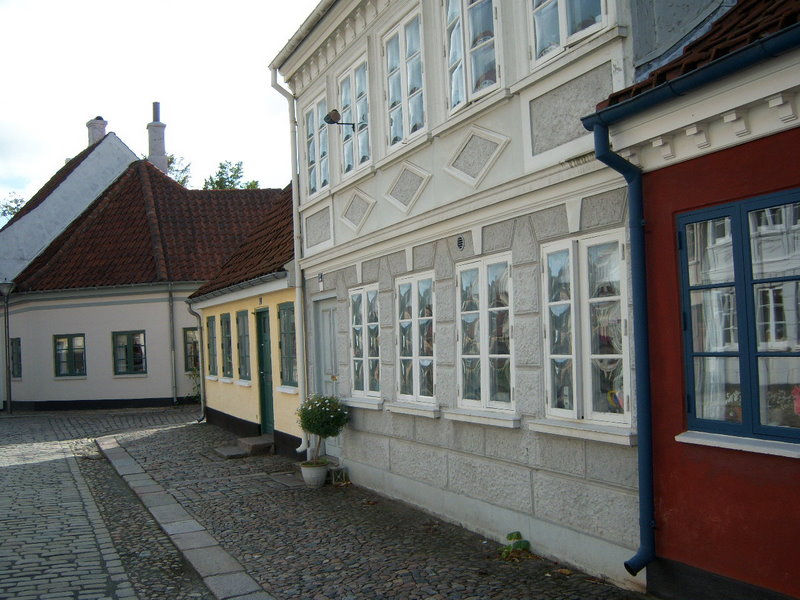
The second home that Andersen lived in as a child, older now.  It looks substantial, with the half timber filled in with substantial bricking - that will last for centuries.  The Yuppie look is deceiving. This was a slum at the time.


Now see the street, where, we are told, his mother walked down to the river to do the washing.  The road does slope right down into it, with cobbles making an underwater road-end for a while.  And so clean and peaceful now.


Note the slope away and up from the sidewalk - a build-in buttressing, as well as weight on the timbers.  His home is again the half-timber in white and brown.


On some of the houses here on the street where his mother walked to the river, are mirrored contraptions fixed to the window sides, and near doors.


Odense DK, busybodies installed on windows

A busybody is installed on a window to reflect who is there at the door below, who is going up and down the alley, and the people on the street can be seen without the watcher even disturbing the curtains. 


They are seen frequently in Philadelphia, where it is said that Benjamin Franklin invented them. They are still sold today, see ://www.franklinbusybody.com/features.asp/  The Benjamin Franklin Busybody.  Read the Busybody history at ://www.franklinbusybody.com/history.asp/

Now:  did Franklin get the idea from his trips to Europe; was he in Denmark, for example; or did Europe get the idea from him?

Odense: Hans Christian Andersen; Birth Home; Life

Scrub, scrub, scrub the history.
Dig Deeper; and Admire the More.

Hans Christian Andersen grew up in poverty, hounded by his difference, targeted as well as ignored, seeking relationship, homely, ungainly, lonely and frustrated. His was a hardscrabble family, but he found his way from pillar to post, this benefactor to that benefactor, from time to time, just enough to keep going, and have his art recognized. Read the unsentimental biography, Hans Christian Andersen, The Life of a Storyteller, by Jackie Wullschlager, the Financial Times art critic.

What was the orientation of Hans Christian Andersen, and does it matter?  Obviously it does, because finding information that relate in that direction takes some digging, and going beyond Wiki.  Try his relationship with Harald Scharff, at page 376 plus or minus, at ://books.google.com/books?id=SZ50_q-diBwC&pg=PA379&lpg=PA379&dq=Harald+Scharff+and+Hans+Christian+Andersen&source=bl&ots=me-0xbM1QU&sig=wsW-zXFkyrHUqn5yQPuYdR2bHFE&hl=en&ei=9RS_TIj8G8G78gaIkPW8Bg&sa=X&oi=book_result&ct=result&resnum=3&ved=0CCMQ6AEwAg#v=onepage&q=Harald%20Scharff%20and%20Hans%20Christian%20Andersen&f=false /  Scharff was a ballet dancer with the Copenhagen Royal Ballet, see ://shop.cosis.net/bookstore/book/3471013/0/COST/BOK/EN9786130838256/HARALD_SCHARFF.html?PHPSESSID=b923627b0b6d46f0173a1baf302f89aa/;  and Karl Alexander August Johann, Grand Duke of Saxony, etc.  Unrequited, requited, pendulum swings to unrequited, but our interest is only in the fact that feelings are human and why must we pretend in our cultures and to our children.

Check the original photos and accounts against the Disney-caged worldview. Admire the gift. Accept the original lifestyle. Why should Disney, and the rest of us, hide reality.

I.  Hans in the Square.

An idealized face, for a homely man.


Hans Christian Andersen sits at a highly visible place at the town square.  Now see the same basic photo a few minutes later:


A shopkeeper added a second head of Hans, half a head, at Hans' toes.  It ruins everybody's picture; and all to lure a few tourist-Kronor into the saucer under the chin of the head.  Snap your wallet shut, O Tourist. Where is the town council when you need them?


Still, we took the picture. Moral:  Get to the Square early for your picture. The disembodied half-head is too heavy to move with your foot, out of the lens view. Paying street performers via their hats on the sidewalk is one thing.  An interloping free-loading shop-keeper is another.  Is there something here we are missing?

II.  Hans at Home

Here is the street where Hans Christian Andersen was born.  It is expanded into a museum now, with the museum entry behind, and a garden, and large addition at the back that is not seen from the street.  Find the museum at this fine site -- ://www.galenfrysinger.com/denmark_odense_anderson_museum.htm/  The site alludes briefly to the lifestyle. Appropriate also not to let that become a focus, when the art is so fine.


Then refer to reality.  From this cute setting, use your imagination for the filth around and despair of early 19th Century poor. Hans Christian Andersen told tough stories.  Children can take it.  Let them in on the secret here.  Add some text or photos of real 19th Century slums, to help educate our children.  Good things can come in conflicted packages, from demeaning sources.


Hans Christian Andersen hus. The Yuppie setting again.


III.  Hans in real life could teach us much more.

Bucolicism does us all a disservice by re-making history. We are only taking pictures of stage sets. Why not set up a stage set of a real slum from the times? Why teach fakery to children. Agenda over truth.

IV.  Hans Rumor

An Odense resident told us as we walked to the square that there have always been rumors that Hans was the son of the King, and that his mother received money from the King throughout her life.  Given the Wullschlager biography, that seems hardly likely.  Still, read this lesser-known story by Hans Christian Andersen from 1853, Everything In The Right Place, at ://hca.gilead.org.il/right_pl.html/

V.  Hans online

Read some of the tales now, before you forget. Click back and forth at the Gilead site, and read more stories by Hans Christian Andersen  How long has it been?

Sunday, September 19, 2010

Slagelse, Ladbyskibbet. Viking Construction: Thatch on Top. Dug Out Below. Culture. Slagelse; Ladbyskibbet

You have to admire thatch.  It can last 30 years, and in Denmark is anchored at the top with oak cappings.  The technique is still used, and on large structures.  It developed early, see ://home.golden.net/~wareham/worldnorse/wntown.html/; and ://www.darkcompany.ca/fullcirc/fulcirc2.php/  Saxons also used the sunken floor idea, see ://www.regia.org/houses.htm - borders were fluid, much go-between, but the Germanic Saxons had some linguistic and cultural differences from the Norse, evolved from their greater exposure to the more southern tribes?

Some thatch is topped with sod, turf and the resulting grass.  Put your goat to work.


The sunken floor adds warmth.

See them on Viking Village reconstructions, particularly structures at Trelleborg on Zealand (see also Ladbyskibet, where the outline of a buried Viking ship is found under the mound, near Kerteminde, Funen -  see://www.travelpod.com/travel-blog-entries/sarahindenmark/denmark/1189800060/tpod.html).

The advantage:  ready materials; and a good hiding place, just tuck your necklace up there, except for the disadvantage.  The disadvantage:  Fire, that spreads fast; and bugs and creepies in residence up there, and falling down.  s paltry as they are.

We wished for more explanations for the whimsical carvings. Are these from originals?  Whimsy looks part of the cultural landscape even then.


The cult of the horse.  Read Horse Burial in Scandinavia in the Viking Age, by Peter Shenk of the University of Oslo at ://www.bahumuth.chaosnet.org/fantasy/writings/​Valhalla.doc.  Is that a horse burial at Roskilde Cathedral. 


Get to the mound on time.  We rely on pictures of the inside for this.


These look like Easter Island.


In some (many) burial sites, the buried ships hold women, and there is other evidence of their holding positions of status, holding substantial purse-strings and managing the community.

Viking theology.  Does this help explain the female figure the same size, if not bigger, than the male.  Or is it?

Culture.  The pre-Christian religious structure suggests that there were three basic areas for the deities to manage:  Odin, in charge of warfare, inspiration for poets, courage for battle, and wind-thunder-storm, and a concept of "the hanged man" that appears still in Tarot;  to whom the more well-to-do responded; Thor, for farmers and the common person; and Freyja for sorcery, incantation, bringing things about, and female sexual power.  Her brother, Frey, stood for male potency but not on the same power scale as the other 3, Odin, Thor and Freya.  This is rough, but go to The Vikings, A History by Robert Ferguson, Penguin Group 2009, at pages around 23.  

Look up the Oseberg ship from Norway at the Ferguson book at about 12.

Reviews of Mr. Ferguson's book highlight scholarly disagreements with his conclusions, see for example, ://www.openlettersmonthly.com/ranvaik-owns-this-box/ .    Our concern is different, and so far not picked up.  Why are pre-Christian people (say, women) who are effective community leaders, able to get things done, heal, "know" how to do things, get dismissed as sorcerers, while the boys are out knocking heads and proud of it.

Next reviewer:  analyze Mr. Ferguson's bias toward the "Christian" fear of women's abilities that reflect in his very characterization of them in that culture -- otherwise unsupported -- in referring to skills that many men simply do not have, or understand.

Is it sorcery, or a way of knowing?  Who ran the show at home anyway, while the guys were off, like the Crusaders or the Vikings.  The women, stupid. Is that so?  Or is this just late at night and we are fed up with surface dismissals by label of one culture smacked on another, like the Church does? Rather routinely?

Saturday, September 18, 2010

Trelleborg - Near Slagelse. Ring Fortress. Viking

Trelleborg - Ring Fortress from the Viking Age
Slagelse, DK

This is still on Zealand, the large Danish island where Copenhagen is located. It is on the west coastal area. First, see a model of what the circular fort area could have looked like, with the protected area elevated, and surrounding grouped longhouses. Find longer descriptions at http://www.copenhagenpictures.dk/trlborg.html/  This area dates from 980 or so AD.  They used the dating method of analyzing rings on wood found there.


The longhouses are bigger than expected. A central smoke hole in a curved roof beam kept air circulating, some. This size could have accommodated some 35-50 people. See video at http://www.youtube.com/watch?gl=US&hl=iw&v=sdYLWObhhY4

That site ties in the construction with the conversion of Harald Bluetooth, a matter not agreed at http://www.denmark.dk/en/menu/About-Denmark/History/The-Viking-Age/TheIntroductionOfChristianity/
Harald and his predecessors had been under political and military pressure from the German side, Otto, and did not on their own see the "merit" of the new religion from the south.


Find a series of photos and other sites at http://www.vikingdenmark.com/trelleborg-viking-fortress-slagelse-denmark.html/  If you arrive here late, and the visitor center is closed, you still have access to the grounds.


Were the people small in stature, or was this small door for warmth and protection, much as castles had some very little doors leading to passageways and little staircases for escape. A fully armed and armored fighter could not enter.

In The Vikings, A History, by Robert Ferguson, Penguin Group 2009 at page 10 notes the examination of a Viking-Age man in a grave mound (the buried Tune Ship) in Norway.  There were thigh bones thirty percent heavier than those of modern men, perhaps from extensive horseback riding.  There was also evidence of a pituitary tumor, however, that could have resulted in some gigantism.

How much is really known about the culture, and how do we know it.  I am still reading The Vikings, and am surprised at how late it was before an era of Vikings was seriously identified -- the 19th Century.  Issues of how to weigh the old sagas, and how much did the recorders of the sagas, acting centuries later, press their own families' agendas in them.  Like now. Text criticism applies to any ancient and modern material.


The circular fortresses of Vikings are known as trelleborgs.  There are several of them in Denmark and Sweden.

Wednesday, September 15, 2010

Roskilde Viking Ship Museum - The Sea Stallion

Roskilde Viking Ship Museum

Vikings are much maligned


It has become accepted lore that the Vikings suddenly and without provocation leaped out of their longboats from their fierce fjords and attacked nice Christian monasteries, Iona in Ireland, Lindisfarne off Northumberland, etc. 

This reconstructed ship, The Sea Stallion, took a crew back to Ireland and England in 2007, returning in 2008. See the film at the Museum. Glendalough is a monastery, now a ruin, in Ireland. See Glendalough, open to Viking raids.  It was subject to repeated raids during the Viking years, by Vikings; but also was targeted by other monasteries and Irish.

The waterways giving access for the Vikings are now largely silted.


That said, the topography looks tame now, but the fjords cut deep into the country, and this town was long vulnerable to raids from other Viking communities to the North - Norway and Sweden. And, conversely, Norwegian and Swedish Viking communties raided Denmark.  At one point, several old (old even then) Viking ships were filled with rocks and sunk at the mouth of the fjord at Roskilde, the old capital, as a protection against invasion, and those ships are now in the Viking Ship Museum in Roskilde. See

Topography and history. Fjords in concept represent the depth and length of waterway, not whether there are mountains on either side.

If anything, lack of mountains, as in Denmark, and most of Sweden, increases the vulnerability.  No place to hide, as in Ireland where the rivers led deep into the country. The towns that used to be on the coast, even closer to open water than now, are now quietly inland with the silting up of the mouths of the fjords. See ://www.vikingeskibsmuseet.dk/index.php?id=1246&no_cache=1&L=1


The angles and curves of the Viking ship - art. Respect the skill, the design.


Again, the Sea Stallion: scourge of Glendalough.


Find it at http://www.rte.ie/vikings/

The ideal first stop after the airport is Roskilde - not just for the Cathedral, but for Vikings.  Here is the Viking Ship Museum, complete with costumes available to enhance the experience -